 |
The Battle of Britain August - September 1940 |
 |
| This year marks the 86th. anniversary of the Battle of Britain, the first military campaign fought entirely in the air, and without doubt one of the most crucial contests in history. In 1940, Hitler's armies had conquered and occupied Holland, Belgium, Luxembourg, Norway, Denmark, and France. The only nation still opposing Nazi Germany militarily was Britain. |
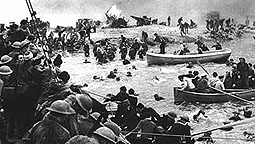 |
Miraculously, in it's retreat from the continent the British Expeditionary Force had managed to save almost all it's personnel, thanks in large part to the hundreds of private pleasure craft which aided in the evacuation from the beaches at Dunkirk. Between 27th May and 4th June, almost 200,000 British troops were evacuated plus nearly 140,000 French, Polish, Belgian and Dutch forces. Although complete disaster had been averted, every piece of armour and heavy equipment was left behind, it would be a long time before the army would be re-equipped and organized sufficiently to mount an adequate defence of the British Isles. |
|
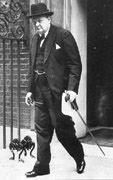
On the 18th. of June, Winston Churchill stood in Parliament and delivered one of historys' most memorable speeches. "What General Weygand called the Battle of France is over. I expect that the Battle of Britain is about to begin. The whole fury and might of the enemy must very soon be turned on us. Hitler knows that he will have to break us in this island or lose the war. If we can stand up to him, all Europe may be free and the life of the world may move forward into broad sunlit uplands, but, if we fail, then the whole world, including the United States, including all that we have known and cared for, will sink into the abyss of a new Dark Age made more sinister, and perhaps more protracted, by the lights of perverted science. Let us therefore brace ourselves to our duties, and so bear ourselves that if the British Empire and it's Commonwealth last for a thousand years, men will still say, "This was their finest hour". |
 |
| The occupation of Britain would give Hitler complete control of Western Europe. While the British army currently posed little threat to the victorious and confident units of the Wehrmacht, the Germans still had the problem of crossing the English Channel. The Royal Navy was a formidable presence, more than a match for the German Kriegsmarine, therefore control of the air over the Channel and the proposed landing grounds in Southern England was absolutely essential if the German invasion was to have any chance of success. Before operation Sealion (the invasion of Britain) could proceed, the RAF had to be destroyed. |
 |
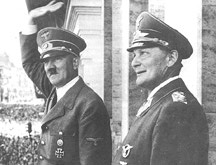 |
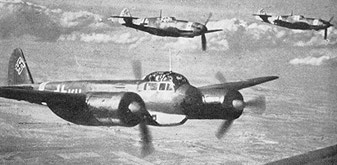
| Ju88 with Me109 escort | Hitler and Goering in confident mood |
| Luftwaffe chief Herman Goering had boasted that the elimination of RAF resistance would be achieved within six weeks. This may not have seemed unduly optimistic at the time, considering the numerical advantage the Luftwaffe enjoyed, and the long run of recent victories to it's credit. Adler Tag, the code name for the day on which the attack would commence, was provisionally set for Aug. 10th. |
 |
 |
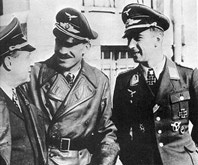
| Centre and right, Adolf Galland and Werner Molders, two of the Luftwaffe's top scoring aces during the battle |
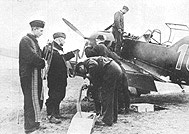
Luftwaffe ground crews prepare a Bf109 for an escort mission to England |
| As of the10th. of August, the Luftwaffe had at it's disposal 875 long range bombers, 316 dive bombers, 702 single-engined fighters and 227 twin-engined fighters. These aircraft belonged to Luftflotte 2 and Luftflotte 3 based in Northern Germany, Holland, Belgium and France. Some 200 more aircraft were based with Luftflotte 5 in Denmark and Norway. Their task was to attack Northern England and Scotland, with the purpose of diverting some of the defending RAF fighters from the main battle in the South East. Thus, a force of approx. 2,300 aircraft was poised to attack the British Isles. |
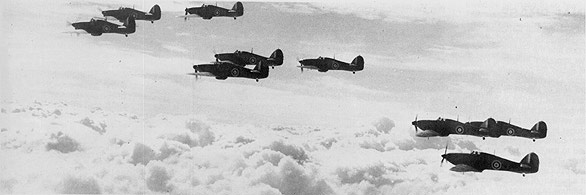 |
| Hurricanes of No. 85 Squadron |
| Despite the overwhelming numerical odds faced by the RAF, Fighter Command did posses some advantages. First of all, British scientists had developed a radar system (Chain Home). This provided early warning of enemy raids, and enabled controllers to scramble fighter squadrons and direct them onto the incoming bomber formations rather than waste energy and fuel flying standing patrols, the available fighter squadrons could now be used more efficiently. Secondly, the RAF fighters were operating close to their bases, and often entered combat with more or less full fuel tanks, whereas the German fighters had already somewhat depleted their fuel supply before reaching the combat area, and had a limited time available before having to return to their bases in France. RAF fighters could land to re-arm and re-fuel in time to be back in the air to meet the next wave of raiders, it was not uncommon for a squadron to fly six sorties a day. Also, if an RAF pilot was shot down, and successfully bailed out, he could be back in the fight later the same day. If the same thing happened to a German pilot, he was out of the war. Finally, and probably not the least important was morale. The German pilots had already enjoyed many victories and were very confident on the eve of battle, they expected a quick victory this time too, and must have been disheartened by the reception they received over southern England. The pilots of Fighter Command on the other hand were literally fighting for the survival of their country, their homes and families, and they knew it. There were of course numerous occasions on which a mere handful of Hurricanes or Spitfires found themselves pitted against a force of 100 or more enemy aircraft, and at times like these any supposed assets must have seemed of little comfort. |
 |
 |
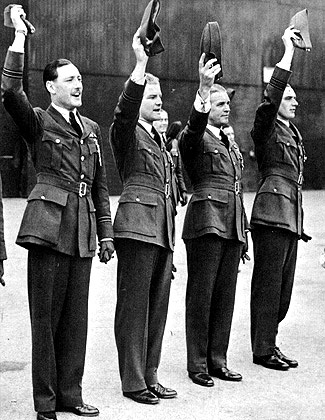
| Robert Stanford-Tuck - Alan Deere - 'Sailor' Malan - James Leathart some of Fighter Command's leading Aces |
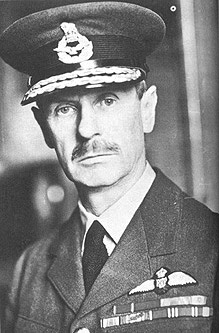
Air Chief Marshal Sir Hugh Dowding (C.O. Fighter Command) |
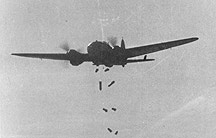
Although Adler Tag had been set for Aug. 10th., the fighting actually started a month earlier. German attacks during the month of June had been scattered and sporadic, but on June 10th. things changed. For the first time, large scale concentrated attacks began, first against shipping in the Channel, followed by raids on coastal towns and ports all along the south and east coasts. The pattern was repeated daily throughout July and into August. |
 |
| Poor weather had delayed Adler Tag until the 12th. of August, when the Luftwaffe began to pay increasing attention to RAF fighter stations near the coast, while keeping up the pressure on other coastal targets in preparation for the invasion. A glance at the daily aircraft losses for this period illustrates the dramatic increase in air fighting. August 24th. saw the start of the third and most crucial phase of the battle. During a short period of poor weather which limited attacks, the Luftwaffe had re-assessed the situation, and now began to concentrate their entire effort on RAF Fighter Command, on the ground and in the air. Hitler had proposed Sept. 15th as the invasion date, and there were just three weeks left in which to destroy the RAF. |
Fighter Command was in real trouble, but Luftwaffe commanders did not fully appreciate the situation. German losses had been far higher than they had expected, especially in bombers, RAF fighter stations continued to operate despite heavy bombing, and consequently the invasion date had been moved back. Hitler, furious at the delay, demanded that the invasion should take place within a week, and that meant the destruction of Fighter Command must be accomplished immediately. Raids on the Capital and fighter stations continued, the battle continued, but it was clear that the attempt to destroy the RAF had failed, for the moment at least, there would be no invasion. No discussion of the Battle of Britain is complete without reference to the famous Winston Churchill quote: |
| "Never in the field of human conflict was so much owed by so many to so few" |