 |
|
Valiant Response
The Hardest Days - Part III
by Robert Taylor
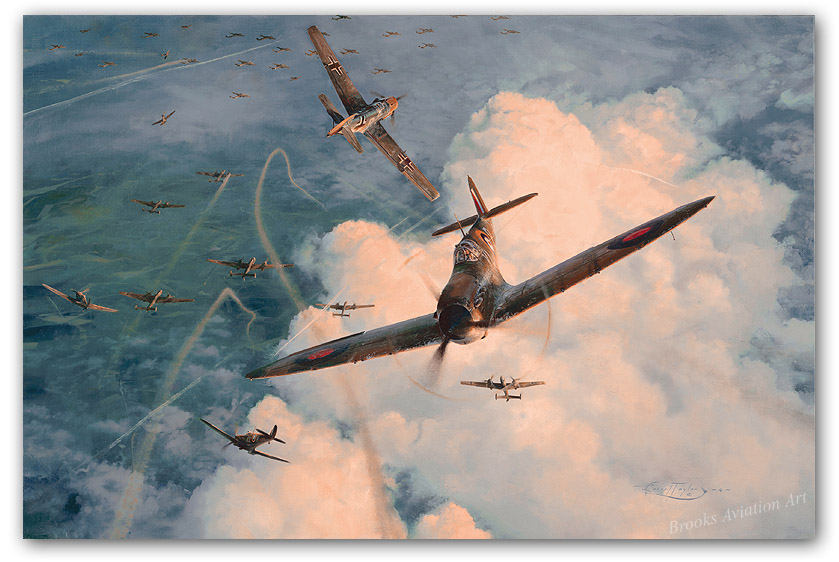
For nearly a week the Luftwaffe had thrown everything they had into the attack on southern England in order to annihilate RAF Fighter Command, and gain air superiority over the Channel in preparation for Operation Sealion, the invasion of Britain. And, heavily outnumbered, the young RAF Spitfire and Hurricane pilots of Fighter Command had so far repelled them, at a cost. Valiant Response is the third and final edition in the series and he has skilfully portrayed the scene as the ‘hardest day’ reaches its climax in the late afternoon. The Spitfires of 54 Squadron, quickly scrambled from nearby Hornchurch, clash with an escort force of Me109s from 1./JG51 over Kent. Below, a formation of Me110s from KPRG210 are about to receive unwelcome attention as the rest of the Spitfires hurtle down upon them; one is already smoking. In the distance, a group of Hurricanes rip through a dense formation of Do17s from KG76 as they also try to struggle back towards France. What clouds there are will be unlikely to give much sanctuary and, for the onlookers on the ground far below, the skies will soon be filled with weaving trails of smoke and debris. |
| Overall size: 25¼" x 33" | Available in the following editions |
| 450 | Limited edition | Signed by three RAF Battle of Britain fighter pilots. | $320 |
| 350 | Anniversary edition | Signed by Ten RAF Battle of Britain pilots and two Luftwaffe pilots. | $395 |
| Limited edition signatures | ||
| Richard C. Jones DFC | Doug Nicholls | Ken Wilkinson |
| Anniversary edition & A/P signatures | ||
| Richard C. Jones DFC | Doug Nicholls | Ken Wilkinson |
| Benjamin Bent | Byron Duckenfield AFC | John Elkington |
| Keith Lawrence DFC | Robin Lucas | William J Corbin |
| Trevor Gray | Günther Seeger | Johannes Steinhoff |
| The Signatories |
| Richard C. Jones Posted to 64 Squadron at Hornchurch in July 1940, Richard Jones flew Spitfires throughout the heavy summer fighting over southern England and the Channel during the Battle of Britain. Towards the end of the fighting he moved to 19 Squadron at Fowlmere, again on Spitfires, as part of the Duxford Wing and was heavily involved in the fighter sweeps taking place at that time. |
| Doug Nicholls A pre-war RAFVR pilot, Doug Nicholls flew Hurricanes during the Battle of Britain with 85 and 242 Squadrons. In September he was posted to 151 Squadron and shared in the destruction of a Ju 88. Later, posted to the Far East, he flew Hurricanes with 258 Squadron in Singapore until the squadron’s three aircraft were withdrawn, and he was evacuated to Ceylon where the squadron reformed. He remained with them until August 1944, when he was posted to Burma as Squadron Leader (Tactics). |
| Ken Wilkinson Called up in September 1939, Ken Wilkinson flew Spitfires during the Battle of Britain, first with 611 Squadron, then 616 Squadron, and finally with 19 Squadron at Fowlmere as part of the Duxford Big Wing. After a spell instructing he returned to flying, again on Spitfires, this time with 234 and 165 Squadrons. After spending time instructing with 53, 24 and 10 Operational Training Units, he left the RAF in November 1945, but continued to serve with the RAFVR. |
| Benjamin Bent Ben Bent joined the RAF in 1937, and flew as a Radar /Wireless Operator on night-fighter Blenheims with 25 Squadron throughout the Battle of Britain. He assisted in five successful interceptions on his first tour, and following a spell as an instructor, he retrained as a Navigator. He rejoined 25 Squadron now flying Beaufighters and in late 1942 went on to Mosquitos, assisting in a total of eight victories including the first enemy aircraft shot down on D-Day. |
| Byron Duckenfield AFC Flying Spitfires, Byron Duckenfield joined 74 Squadron in April 1940 at Hornchurch in April 1940, another notable squadron who had fought on the Western Front during WWI. Heavily engaged during the Battle of Britain, in July 1940 he was posted to 501 Squadron flying Hurricanes first at Middle Wallop, then to Gravesend, scoring his first victory, a Ju87, on the 29th. During August and September he scored three more victories. After a spell instructing he was posted to command 66 Squadron at Perranporth, and in February 1942 to command 615 Squadron, which he took to the Far East. In late December 1942 he was shot down in Burma and captured by the Japanese. He remained a POW until release in May 1945. |
| John Elkington ‘Tim’ Elkington joined the RAF in September 1939. Commissioned as a Pilot Officer in July 1940 he was immediately posted to join 1 Squadron flying Hurricanes at Tangmere. On 15 August he shot down an Me109 over the Channel, but the following day he was himself shot down over Thorney Island. He baled out injured and was admitted to hospital, his Hurricane crashing at Chidham, near Chichester. In May he joined 601 Squadron at Manston before being posted to 134 Squadron with whom he went to Murmansk in Russia. In August 1942 he briefly returned to 1 Squadron, before spells with 539 and 197 Squadrons. At the end of 1943 he joined 67 Squadron in north-east India and was heavily engaged in fighting the Japanese in Burma. |
| Keith Lawrence DFC Keith Lawrence flew Spitfires during the Battle of Britain first with 234 Squadron, where he shared in the squadron’s first victory, and then in September with 603 Squadron, and 421 Flight. During the Battle of Britain he destroyed two enemy aircraft and damaged four more. On 26 November he was shot down over the sea. Recovering from his injuries he was posted to Malta in January 1942 and joined 185 Squadron, flying Hurricanes. During the heavy fighting that spring he destroyed or damaged 7 enemy aircraft. The squadron converted to Spitfires, and he was made commanding officer, returning to England in August. After instructing he returned to combat in February 1945 as CO of 124 Squadron. His tally stood at 5 victories and 9 damaged. |
| Robin Lucas Flight Lt Robin Lucas flew Boulton-Paul Defiants during the Battle of Britain with 141 Squadron as part of 11 Group and was involved in heavy fighting over the Channel, and on convoy patrol. In September 1940 Robin and the rest of the squadron went over to night-fighting and became one of the most successful units in 11 Group. |
| William J Corbin Already a member of the RAFVR, William Corbin was called up for active duty in September 1939. Following training and conversion to Spitfires, in August 1940 he was posted as a Sergeant Pilot to join 66 Squadron at Coltishall. With the exception of a few weeks spent with 610 Squadron he remained with 66 Squadron until September 1941. Commissioned in June 1942, he returned to combat flying in September, joining 72 Squadron with whom he went to North Africa. Here he shared in a probable Me109 and damaged another, and in August 1943 was awarded the DFC. |
| Trevor Gray In September 1940, at the height of the Battle of Britain, Trevor Gray flew Spitfire Mk1s with 64 Squadron at RAF Leconfield, and a month later the Squadron joined the Hornchurch Wing. |
| Günther Seeger In February 1940 Günther Seeger was an Unteroffizier with 3./JG2, scoring his first victory in the early days of the Battle of Britain. He served on the Channel Front until December 1942, including several months with the Geschwaderstabsschawm. He transferred to the Mediterranean theatre with 11./JG2, before joining 6./JG53. In February 1943 he joined 7./JG53, becoming Staffelkapitan in September 1944. Awarded the Knight’s Cross, G..nther Seeger flew over 500 combat missions and scored 56 victories, all of them in the West. |
| Johannes Steinhoff By early 1940 ‘Macky’ Steinhoff was leading 4./JG52, flying throughout the Battle of Britain. In June 1941 JG52 transferred to the Eastern Front where he commanded 11./JG52. He later served in Italy until moving to France after the Allied invasion in Normandy. In late 1944 he commanded the first Me262 unit, JG7, before joining Galland’s JV44, where he scored 6 jet victories before being seriously burned in a crash. He had scored 178 victories, and awarded the Knight’s Cross, Oak Leaves, and Swords. |
 Air Armada |
 Hornchurch Scramble |