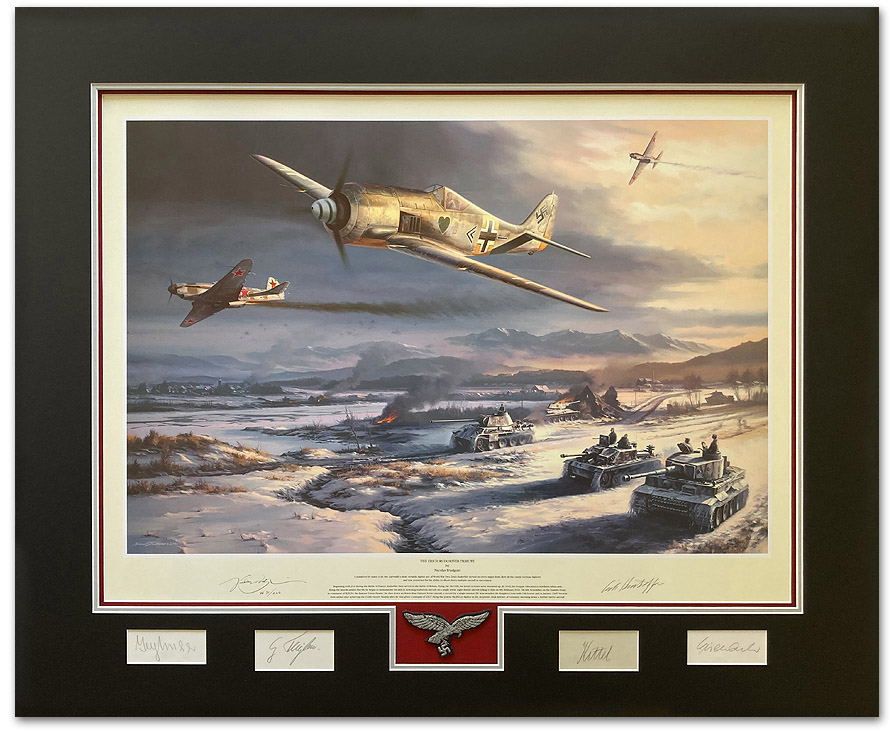
 |
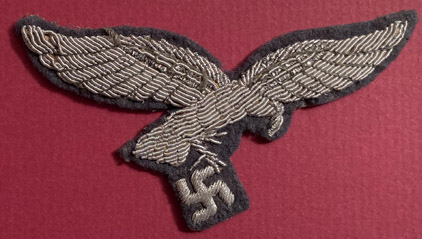
Luftwaffe officer's breast eagle Included in the mount is an original WWII Luftwaffe officer's breast eagle. This example retains very small traces of thread in the edge of the backing material, and exhibits slight signs of wear that indicate it was issued and uniform-worn. An authentic WWII artifact in very good condition. (Officers breast eagles differed from those worn by enlisted men and NCOs in that silver thread was used and they were usually hand embroidered.) |
|
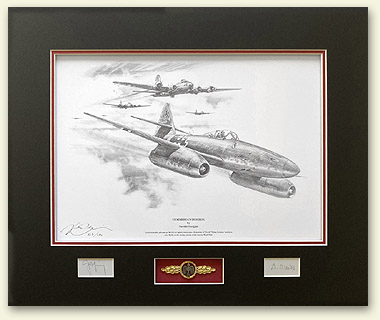 |
This has been conservation mounted to include the signatures of two Me262 pilots - Alfred Ambs and Ernest Giefing.
|
|
| click to enlarge |
| The signatures |
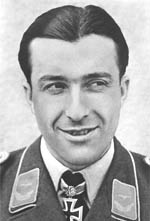 |
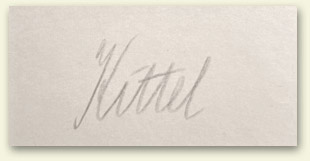 Otto Kittel wartime autograph included in the mount |
| Otto Kittel (21 February 1917 – 16 February 1945) Kittel joined the Luftwaffe in 1939 and was posted to Jagdgeschwader 54 following traing. In early 1941 his squadron was stationed in Holland where it stayed until moving to northern Germany in May, shortly thereafter beginning preparations for Operation Barbarossa. In early June JG 54 had been moved to an airfield in Lindenthal near Rautenberg, East Prussia, tasked with supporting Army Group North in its advance through the Baltic states towards Leningrad, the unit began combat operations shortly afterwards. On 24 June 1941, Kittel claimed his first two aerial victories, two Tupolev SB-2 bombers. His tally had risen to 19 by May 1942. In mid-December 1942, I. Gruppe began converting to the Focke-Wulf Fw 190, it was in this aircraft that Kittel would score the majority of his victories. On 9 February 1944, Kittel was appointed Staffelkapitän of 3. Staffel of JG 54 and on 4 April 1944, hel claimed his 150th aerial victory. I. Gruppe pilots claimed thirteen aerial victories during an action that morning, four Il-2s and nine fighter aircraft, including five claims by Kittel, taking his total to 151. He continued to add to his victories until on 16 February 1945 he was shot down in his Fw 190 A-8 southwest of Tukums over the Courland Pocket. He was hit by return fire from an Il-2 ground attack aircraft. His wingman later reported that his aircraft was hit, descended towards the ground on fire and crashed in flames. - Otto Kittel flew 583 combat missions and scored a staggering 267 aerial victories. |
|
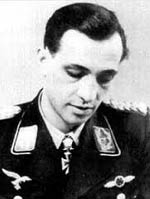 Erich Rudorffer Erich RudorfferConsidered by many to be the Luftwaffe’s greatest all-round fighter ace of World War Two, Erich Rudorffer served on every major front, flew all of the classic German fighters and was renowned for his ability to shoot down multiple aircraft in succession. Beginning his campaign with JG2 during the Battle of France, Rudorffer then served in the Battle of Britain alongside top aces such as Helmut Wick and Gunther Seeger. Flying the Me109E, his aerial victories soon mounted, and he continued to joust with the RAF during the ’Non-stop’ offences of 1941. By the time of the ill-fated Dieppe Raid in 1942, Rudorffer scored his 44th and 45th victories, both Spitfires. His Gruppe was then relocated to northern Africa where the war was going badly for the Axis forces. Now flying the heavily-armed Fw190, he began to demonstrate his skill at downing a number of aircraft on a single sortie. On the 9th February 1943 he claimed eight British aircraft and a short time later scored multiple victories over US-flown fighters. By June of the same year, Erich had moved to the brutal Eastern Front, assuming command of II/JG54, the famous ‘Green Hearts’, and continued to display his remarkable ability. On the 6th November 1943, he tangled with a large force of Soviet aircraft and shot down no fewer than thirteen of them, a record for a single mission. By this time Rudorffer had already been awarded the Knight’s Cross with Oak Leaves and in January 1945 ‘Swords’ were awarded to this decoration after achieving his 212th victory. Shortly after, he was given the command of I/JG7, flying the potent Me262 jet fighter in the defence of Germany. Despite the dreadful war situation, lack of fuel, marauding Allied fighters over the jet airfields and heavily outnumbered in the air, he managed to shoot down a further twelve aircraft with the Me262. By the war’s end, Erich Rudorffer had flown more than 1000 sorties, scored 224 victories and was the seventh-highest Ace in the history of aerial combat |
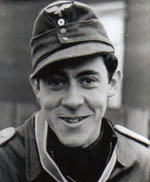 Gerhard Thyben Gerhard ThybenThyben volunteered for military service in the Luftwaffe on 15 July 1940. After flight training, two periods of arrest and several further delays Thyben arrived in Russia with JG3 during January 1943. He claimed his first aerial victory on 26 February when he shot down a Lend-Lease Douglas A-20. On 1 April 1943, Thyben was promoted to Unteroffizier and on 25 May 1943 following his sixth aerial victory, he was awarded the Iron Cross 2nd Class. On 30 September he was credited with his 100th aerial victory. He was the 93rd Luftwaffe pilot to achieve the century mark. Following his 156th aerial victory, Thyben was awarded the Knight's Cross of the Iron Cross with Oak Leaves on 8 April 1945. On 8 May, with his mechanic Albert Mayers as a passenger in the radio compartment, Thyben and his wingman Feldwebel Fritz Hangebrauk flew west. Over the Baltic Sea, he shot down a Petlyakov Pe-2 bomber. Thyben caught the reconnaissance Pe-2 at 07:54 and achieved what very well might have been the last Focke-Wulf Fw 190 victory of World War II. |
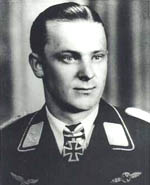 Fritz Tegtmeir Fritz TegtmeirFritz Tegtmeir joined the Luftwaffe and following flight and fighter pilot training he was posted to the 2. Staffel of Jagdgeschwader 54 in October 1940. Tegtmeir’s squadron had just been withdrawn from the English Channel, where it had fought in the Battle of Britain, and was moved to Wangerooge, where they flew fighter patrols over the German Bight. Here, Tegtmeier was severely injured on 17 November, when his Bf 109 E-1 suffered engine failure, resulting in a crash landing. Tegtmeier returned to his Staffelin the spring of 1941 and in June his unit arrived in Russia for Operation Barbarossa. On 11 September he was again severely injured in a collision in his Bf 109 F-2, resulting in a crash landing at Ziverskaya. He returned to active duty in April 1942 and was assigned to 1. Staffel of JG 54. By the end of 1942, he had claimed 24 aerial victories. On 14 January 1943, Tegtmeier became an "ace-in-a-day" for the first time. In May he was posted to Ergänzungs-Jagdgruppe Ost where he served as a fighter pilot instructor. In September 1943, he returned to front line duty, this time with 3. Staffel of JG 54. He was awarded the Knight's Cross of the Iron Cross on 28 March 1944, following his 99th aerial victory. He claimed his 100th and 101st aerial victories on 3 May 1944. On 1 September 1944, he was made Staffelkapitän of 3. Staffel. He succeeded Leutnant Otto Kittel who was transferred. By the end of 1944, his score of aerial victories stood at 139. When he was transferred to Jagdgeschwader 7 for flight training on the Messerschmitt Me 262 jet fighter in March 1945, his score stood at 146 aerial victories. |
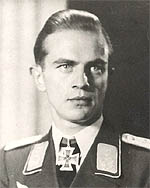 Franz Eisenach Franz EisenachEisenach entered the Luftwaffe in 1937 and by 1939 he attained the rank of Leutnant. From 1940 he flew with various Groups, until joining 9./Jagdgeschwader 54 on the Eastern Front in October 1942. He became Staffelkapitän of 3./JG 54 with prominent success, but was badly wounded in December 1943. On 1 May 1944, he was promoted to the rank of Hauptmann. In June 1944, he was serving with I./JG 54, based in Courland on the Eastern front, he became ruppenkommandeur of I./JG 54 but in September 1944 he was wounded again, this time after an encounter with a bomber. Awarded the Knights Cross, he returned to combat until the war's end. His final tally was 129 victories claimed in 317 combat missions. After the war he was confined as a British POW. Major Franz Eisenach re-joined the military |