NJG-1
by Michael Turner
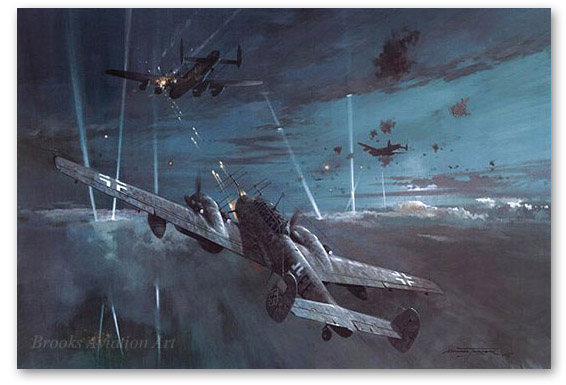
| During late 1944, RAF Bomber Command was sending huge formations of Lancaster bombers over Germany night after night. During this massive offensive the Lancaster crews were attacked relentlessly by Luftwaffe ME-110 Night Fighters. Major Heinz-Wolfgang Schnaufer, with 121 aerial victories, was the most successful night fighter pilot of WWII, and scored his 100th kill at 8:55 PM on the 9th of October 1944 over the Ruhr Valley, the event depicted here. |
| Overall size: 18" x 24½" | Available in the following editions |
| 750 | Limited edition | Signed by eleven NJG-1 air crew (9 pilots - 2 radio operators) all Knight's Cross recipients. | $450 |
| The C.O.A. includes a statement signed by Fritz Rumpelhardt (Schnaufer's radioman) certifying the accuracy of the scene depicted. |
| The Signatories |
Major Martin Drewes Previously serving as a Panzer Lieutenant, Drewes transferred to the Luftwaffe on Sept. 1st. 1939. He first served with ZG-76 which transferred to the Balkans in April 1941 where Drewes flew sorties over Iraq and Syria and scored his first kill over Baghdad May 20th. Drewes was assigned to NLG-1 in August 1943 and served as squadron commander of 11./NJG-1. In February he was appointed as the Kommandeur of III/.NJG-1 where he remained until the end of the war. During his career he flew 235 sorties and scored 52 victories. |
Oberst Wolfgang Falck Falck was one of the pilots who secretly trained in Russia before the war. He participated in the Polish campaign as Staffelkapitan of 8./JG-132 which was later designatued as 2./ZG-76 with which he scored his first victories. Dubbed as the “Father of the Night-Fighters”, he established NJG-1 and served as it’s Kommodore from June 1940 to June 1943. Falck was awarded the Knight’s Cross inOct. 1940 and was recognized for his efforts in building up the Luftwaffe’s night-fighter forces. Falck scored 7 victories plus one unconfirmed. |
Hauptmann Hermann Greiner Greiner joined the Luftwaffe in 1938. He trained as a reconnaissance pilot, later tranferred to a Destroyer unit and finally a night-fighter. He served with NJG-1 briefly in 1941, then with NJG-2. He was assigned as a night-fighter flight instructor late in 1942 and later returned to NJG-1 in May 1943. He ended the war with 51 victories - 47 of which were night actions. Greiner was one of the most successful Lufwaffe night-fighter pilots. |
Oberstleutnant Hans-Joachim Jabs Jabs began his service as a fighter pilot in 1938, later transferring to a Destryer unit where he flew during the French Campaign, scoring his first victories. He was re-trained as a night-fighter pilot and joined NJG-1 as Staffelkapitan of 11./NGJ-1. Having gained 45 victories he was later appointed Commander of NJG-1. Jabs scored a total of 50 victories, 19 as a Destryer pilot and 31 as a night-fighter. |
Hauptmann Fritz Lau Lau was a a pilot with Lufthansa prior to 1939 and was drafted into the Luftwaffe at the beginning of the war. He was first flying transport aircraft, then became a specialist instructor at the blind flight school. In Summer 1943 he was transferred to night-fighters and appointed as squadron Commander of 4./NJG-1. In April 1945 Fritz Lau was awarded the Knight’s Cross after his 28th. night victory. |
Hauptmann Ludwig Meister Meister joined in 5./NJG-1 in October 1941, scoring his first victory on the night of Nov. 30th. He was subsequently appointed as squadron Commander of 1./NGJ-4 in August 1943. In March 1944 he was shot down and severly injured, after recovering he returned to his squadron in August 1944. In December he was promoted Gruppenkommanddeur of III./NJG-4. He ended the war with 39 confirmed areial victories. |
Major Hubert Rauh Rauh had originally been a member of the Austrian Air Force as of 1935 and was a pilot instructor from 1937 onwards. In 1941 he was trained as a night-fighter and joined 4./NJG-1 in January 1942. Rauh was later appointed Kommandeur of 11./NJG-4. During his time as a night-fighter, in defence of the Reich, Hubert Rauh was shot down and injured three times. He ended the war with a total of 31 night victories, 29 of which were four-engineed bombers. |
Leutnant Fritz Rumpelhardt Rumpelhardt was undoubtedly the most successful radio operator of the German night-fighter force. His working relationship with the famous top night-fighter Ace Major Heinz Schnauffer began in 1941. Both were trained at the Destroyer school and the Night-Fighter school, after which they were assigned to 5./NJG-1. Rumpelhardt accompanied Schnauffer throughout his career as the most successful of all night-fighters. Rumpelhardt was credited with 68 kills. |
Hauptmann Dietrich Schmidt Schmidt joined 8./NJG-1 in September 1941. In July 1943 he was promoted to Staffelkapitan of 8./NJG-1. He scored steadily and ended the war with 40 confirmed victories, one Mosquito and thirty nine four-engined bombers. |
Oberleutnant Erich Weissflog Weissflog joined 6./ZG-76 as an airman 1st class, where he became the radio operator for Hans-Joachim Jabs. Initially Weiss had been flying operational missions over France and England as a Destroyer pilot, then joined the night-fighters of IV./NJG-1 where he accompanied Jabs on almost all of his sorties, and was soon appointed as an officer. He was later assigned as intelligence officer to NJG-1 headquarters. |
Oberfeldwebel Johannes RichterRichter was radio operator to Rudolf Schoenert and one of the few radio operators of the night-fighters to be awarded the Knight’s Cross (after 61 shared kills). Altogether he shared 67 kills and an additional kill by himself with the aircraft machine-gun. |
| Receive your print fully framed and ready to display. Please call or email us for a custom framing quote. |