 |
|
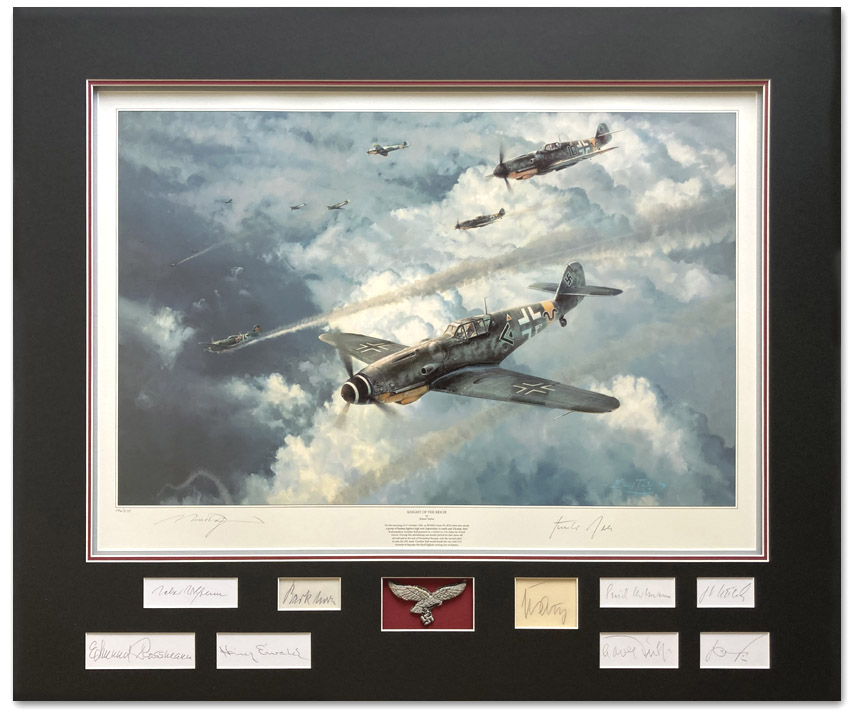
Knight of the Reich
by Robert Taylor
| - Including the wartime signatures of Gerhard Barkhorn and Wilhelm Batz - |
The morning of 15 October 1943 dawned like many others over the Ukraine, the chill in the air hinted at the prospect of another winter of savage fighting on the Eastern Front. But it wasn't the forthcoming winter that was on the minds of the fighter pilots of III./JG52, it was their Russian adversaries. Ever since the battle for Kursk the Wehrmacht had been on the defensive as the Russians counter attacked, beginning a military offensive that would eventually lead to the gates of Berlin. As the German Army fell back, JG52 was forced back too, moving from one makeshift base to another, but they were still feared by the growing numbers of an ever- improving Soviet Air Force. And for good reason, for within its ranks JG52 held some of the highest scoring and most formidable fighter Aces in the history of aerial warfare. |
| Overall size: 28½" x 34" | Museum presentation | |
| With the signatures of ten JG-52 Aces including Hartmann, Barkhorn, Batz and Rall plus an original WWII Luftwaffe officer's breast eagle | |||
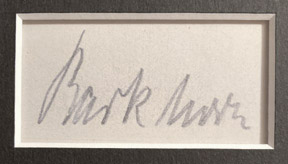
| This print is triple matted with a shadow box layer to include the original signature of the Ace of Aces - Erich Hartmann, the wartime signatures of Gerhard Barkhorn and Wilhem Batz (a particularly rare item) and the signatures of a further six JG-52 Aces. Together with Günther Rall on the print itself, this piece includes the signatures of the three highest scoring fighter pilots in history (and the four highest scoring Aces of JG-52). The combined score of all signatories amounts to a stunning 1,789 victories. |
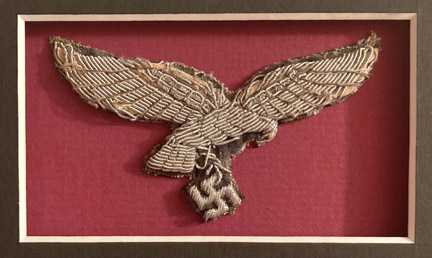
Luftwaffe officer's breast eagle Included in the mount is an original WWII Luftwaffe officer's breast eagle. This example retains small traces of thread in the edge of the backing material and exhibits signs of wear clearly indicating it was issued and uniform-worn. An authentic WWII artifact. (Officers breast eagles differed from those worn by enlisted men and NCOs in that silver thread was used and they were usually hand embroidered.) |
|
 |
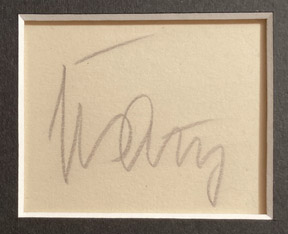 |
| Wartime Barkhorn and Batz signatures included in the mount | |
| The signatures |
In October 1942 Hartmann joined 7./JG52 on the Eastern Front and in August 1943, a month when he scored 48 victories, was shot down and taken prisoner, later escaping. In August 1944 he reached 300 victories after downing 11 aircraft in one day, taking command of 9./JG52. Promoted to Gruppenkommandeur of I./JG52 he trained on the Me262 before returning to JG52. Flying over 1400 combat missions he was forced to crash land 14 times and achieved 352 victories to become the highest scoring Ace in history |
|
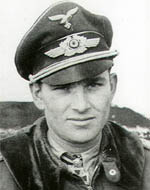
Gerhard Barkhorn (matted wartime signature) |
|
|
|
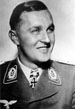
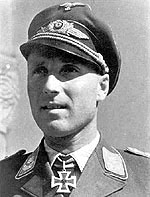 Wilhelm Batz (matted wartime signature) Wilhelm Batz (matted wartime signature)Batz joined the Luftwaffe in 1935 and completed his flight training in 1939, first serving as a flight instructor before receiving fighter training. In February 1943, Batz was transferred to II. Gruppe of Jagdgeschwader 52 and claimed his first aerial victory on 11 March 1943. Following his 100th aerial victory he was awarded the Knight's Cross of the Iron Cross on 26 March 1944. He was given command of III. Gruppe of JG 52 in April 1944 and command of II. Gruppe of JG 52 in February 1945. Batz was awarded the Knight's Cross with Oak Leaves and Swords in April 1945. During his career Batz flew 445 combat missions and claimed 237 aerial victories, making him the fourth highest scoring Ace of JG-52, the most successful fighter unit in history. |
|
 |
Walter Wolfrum (matted signature) Wolfrum entered the Luftwaffe as a volunteer in October 1940. In February 1943 he was transferred to the Crimea with the 5./JG 52. and by April 1944 he had scored 70 victories. He continued increasing his score, being shot down himself several times and being wounded and hospitalized in July 1944. He returned to the front in February 1945 as Oberleutnant and resumed command of 1. / JG 52. When the war ended he had achieved 137 victories in 423 operational sorties. |
 |
Adolf Dickfeld (matted signature) Dickfeld attended flight school in 1934 and 1935 before officially joining the Luftwaffe on 1 January 1939. At the outbreak of war Dickfeld was transferred to 2./JG 52 where he flew missions during the Battle of France and the Battle of Britain, in 1941 he also flew in the Battle of Crete before JG 52 was sent to the Eastern Front for operation Barberossa. He scored his 100th. victory in May 1942.Dickfeld went on to fly with JG 2 in North Africa and later became commander of JG 11. He ended the war with 136 aerial victories hvaing flown 1,072 combat missions. |
 |
Franz Woidich (matted signature) Woidich joined the 5./ JG27 on 11 July 1941, then stationed in North Africa. He claimed two aerial victories there before being transferred to the 3./JG 52 on the Eastern Front on 1 April 1942. He took command of 3./JG 52 on 11 June 1943 by which time his score had increased to 16 victories. He was decorated with the Knight's Cross of the Iron Cross on 11 June 1944 following his 80th victory. Woidich later flew the Me163 with JG-400 scoring one of the very rare Me163 victories. Woidich flew approximatelly 1,000 combat missions and ended the war with 110 aerial victories |
 |
Edmund Rossmann (matted signature) Rossmann was posted to 7. Staffel of JG 52 on 1 March 1940 holding the rank of Unteroffizier. During the Battle of Britain Rossmann claimed two victories after which JG 52 was withdrawn to Holland. The unit was later sent to Rumania to help defend the oil fields and refineries at Ploesti, and then to Greece where they took part in the Battle for Crete. During Operation Barbarossa Rossmann scored further victories and by the end of 1942 had accumulated a score of 80. Rossmann flew 640 combat missions and scored a total of 93 aerial victories. |
 |
Heinz Ewald (matted signature) After his pilot training in the fall of 1943 Ewald was posted to 6. /JG 52 on the Eastern Front and was soon one of the best young pilots of his group and frequently flew as wingman to Gerhard Barkhorn. On his fourth sortie, and on his first enemy encounter, he shot down his first opponent on 11 December 1943. On 17 December 1943, Ewald made a forced landing, on 21 March 1944, he was shot down by anti-aircraft artillery and on 24 June, he was again shot down. Ewald flew 396 combat missions and ended the war with a total score of 84 victories. |
 |
Viktor Petermann (matted signature) Peterman entered the Luftwaffe in July 1939 and joined JG 52 in October 1941, scoring his first victory on 1 July 1942. He was transferred to II. Gruppe of JG 52 in February 1943. There, he was assigned to 4. Staffel under command of Obt. Gerhard Barkhorn. In January 1945, Petermann was appointed Staffelkapitän of 10. Staffel of JG 52, then on 30th. March he was transferred to III. Gruppe of Jagdgeschwader 7 "Nowotny", the first operational jet fighter unit. Petermann claimed one probable aerial victory flying the Messerschmitt Me 262. Petermann finished the war credited with 64 aerial victories, then the third most successful fighter pilot of III. Gruppe. |