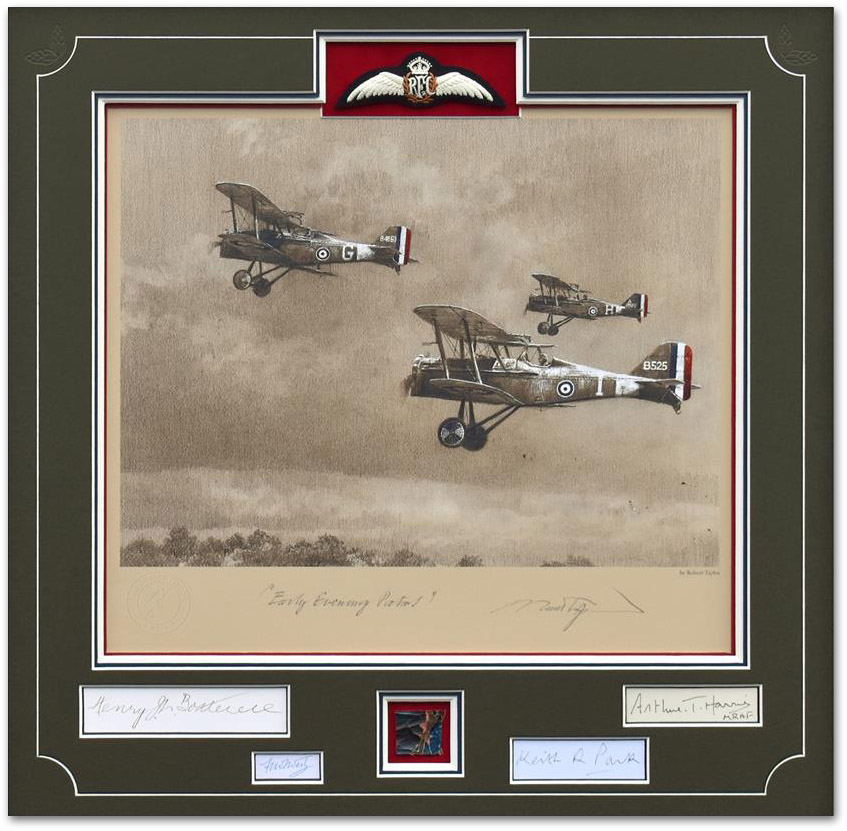
Early Evening Patrol
by Robert Taylor
| Led by Captain James McCudden, the SE5a's of 'B' Flight, 56 Squadron RFC head out from the airfield at Estrée Blanche, north-eastern France, on an early evening patrol, September 1917. Scarcely a decade had passed since the Wright brothers had made the first-ever flight of a power-controlled aircraft, but it was time enough for the world's great military powers to fully grasp the notion of air power. By the summer of 1914 and the outbreak of World War I, every belligerent army possessed some form of fledgling air force, and over the next four years of conflict their pioneering airmen would write the basic rules of air combat. They did so the hard way - through trial and deadly error. It didn't take long, however, for the
press to latch on to colourful tales of aerial derring-do coming from the Western Front with novel
words such as flying ace, air supremacy, and dogfighting appearing. The names of Manfred von
Richthofen 'The Red Baron', and Ernst Udet began hitting the headlines in Germany whilst in
Britain the great Canadian pilot Billy Bishop VC shared column inches with the likes of Mick
Mannock VC and James McCudden VC. It is McCudden's flight of SE5a fighters that form the
centrepiece of the late Robert Taylor's masterful drawing Early Evening Patrol. |
| Overall size: 21" x 21½" | Available in the following editions | Image size: 11½" x 15¼" |
| 15 | Veteran's edition | Signed by the artist, mounted with 4 WWI pilot signatures & fragment of WWI aircraft fabric. | |
Note: Serial number 1 was mounted with additional signatures and original wings and was sold prior to the release of this edition. |
|||
| SOLD OUT |
| The signatures |
|
| Air Commodore Ferdinand Maurice Felix 'Freddie' West VC CBE MC (1896-1988) West joined the British Army in 1914 at the outbreak of war, later transferring to the Royal
Flying Corps, training as an observer at Brooklands, and returning to France in April 1917. After
six months and 225 flying hours he was posted back to Britain to undergo pilot training at
Grantham. He was then posted to No 8 Squadron in January 1918. On 21 April 1918 West ,
witnessed the last combat and fall of Manfred von Richthofen.While flying a reconnaissance mission in August 1918 West and his observer spotted an enemy
concentration through a hole in the mist. Avoiding severe ground fire, almost immediately they
came under attack from seven German fighter aircraft and West was hit in the leg, and his radio
transmitter was smashed. |
|
| Flight Lieutenant Henry John Lawrence Botterell (1896-2003) A Canadian national, Botterell joined the Royal Naval Air Service in 1916 and was sent to
England for training, receiving his wings on August 15, 1917. In September, Botterell joined No. 8 Naval Squadron. The squadron, which was usually referred
to as Naval 8, was soon posted to France in support of the Royal Flying Corps. Botterell's
immediate superior was also a Canadian, the flying ace Flight Commander James White. The
squadron was commanded by another ace, Squadron Commander Christopher Draper, who was
later known as the "Mad Major" for his habit of flying under bridges. |
|
| Marshal of the Royal Air Force Sir Arthur Travers Harris 1st Baronet GCB OBE AFC (1862-1984) When the First World War broke out in August 1914, Harris did not learn of it for nearly a
month, being out in the bush at the time. Despite his previous reluctance to follow the path his
father had had in mind for him in the army, and his desire to set up his own ranch in Rhodesia,
Harris felt patriotically compelled to join the war effort. He quickly attempted to join the 1st
Rhodesia Regiment and was sworn in on 20 October 1914. Harris learned to fly at Brooklands in late 1915 and, having been confirmed in his rank, then went on to serve with distinction on the home front and in France during 1917 as a flight commander and ultimately CO of No. 45 Squadron, flying the Sopwith 1½ Strutter and Sopwith Camel. Before he returned to Britain to command No. 44 Squadron on Home Defence duties, Harris claimed five enemy aircraft destroyed and was awarded the Air Force Cross (AFC) on 2 November 1918. He finished the war a major. Harris was one of the most prominent figures of WWII as head of RAF Bomber Command, and the architect of history’s most intense bombing campaign. |
|
| Air Chief Marshal Sir Keith Rodney Park GCB KBE MC* DFC (1892-1975) SSoon after outbreak of the First World War, Park enlisted in the New Zealand Expeditionary
Force (NZEF) on 14 December 1914, and was posted to the Field Artillery. In March, Park's
battery, along with the rest of the 29th Division, was shipped to the Western Front and assigned
to a sector along the Somme. On 21 October, while trying to withdraw an unserviceable gun for
repair, Park was blown off his horse by a German shell. Wounded, he was evacuated to England
and medically certified "unfit for active service", which technically meant he was unfit to ride a
horse. After a brief remission recovering from his wounds, he joined the Royal Flying Corps
(RFC) in December. Following the outbreak of the Second World War Park joined Fighter Command and became commander of No. 11 Group, the group responsible for the fighter defence of London and southeast England, the area of the most intense air fighting during the Battle of Britain. |
 |
Receive your print fully framed and ready to display. Please call or email us for a custom framing quote. |