 |
|
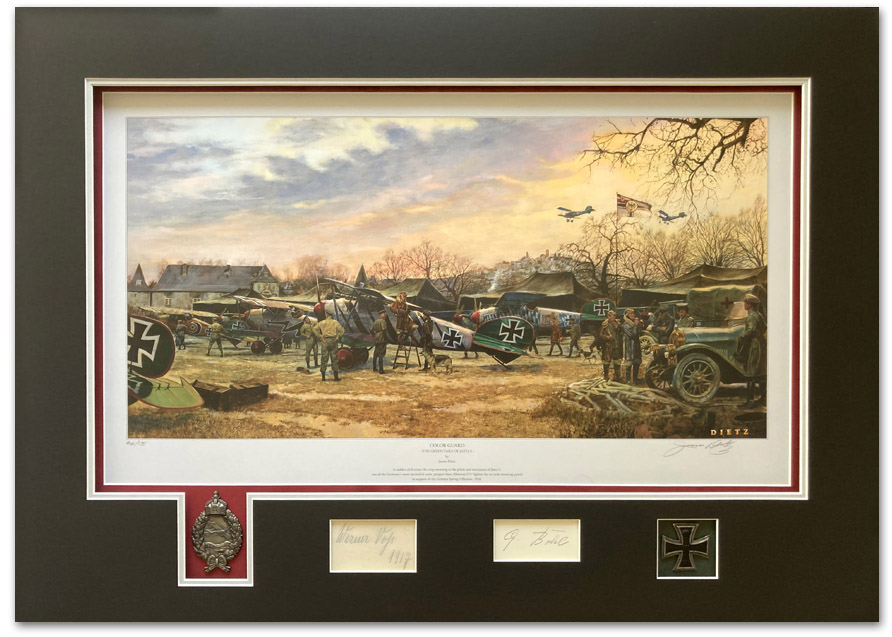
Color Guard
by James Dietz
- Werner Voss -
Top aviation artist James Dietz resurrects the colourful fighters of Jasta 5 with a powerful painting in which he captures the units’ pilots and mechanics preparing their Albtross D.Vs for an early morning patrol. |
| Overall size: 21⅛" x 29¾" | Image size: 11¼" x 22½" |
| Museum Presentation | With the original signatures of Werner Voss & Gustav Boehl plus an original Iron Cross 1st Class | $2095 |
| Archive Presentation | As above but with replica Iron Cross 1st Class. | $1685 |
* Please note; there is just one copy of this piece which can be supplied with either an original Iron Cross or a high quality replica. |
||
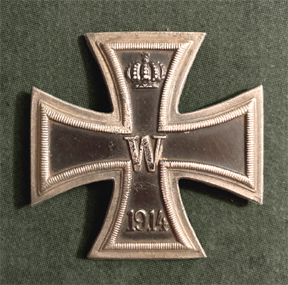 |
Available in the Museum version is an original WWI Iron Cross 1st. Class.
|
|
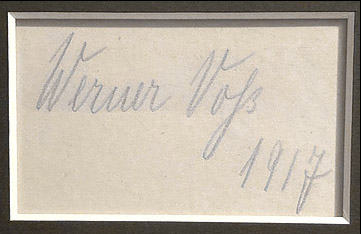 (Original Werner Voss signature included in the mount) |
|
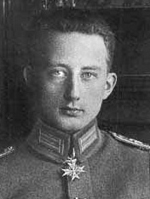
Werner Voss (13 April 1897 – 23 September 1917) A dyer's son from Krefeld, Voss was destined to become one of the legendary figures of the 'Great War'. He was a patriotic young man while still in school, and began his military career in November 1914 as a 17-year-old Hussar. After turning to aviation, he proved to be a natural pilot. Following flight school and six months in a bomber unit, he joined a newly formed fighter squadron, Jagdstaffel 2 on 21 November 1916. There he befriended Manfred von Richthofen. By 6 April 1917, Voss had scored 24 victories and awarded Germany's highest award, the Pour le Mérite. Soon after Voss returned from leave, he was at odds with his squadron commander. He was detailed from his squadron to evaluate new fighter aircraft and became enthusiastic about the Fokker Triplane. After transferring through three temporary squadron commands (including Jasta 5) in two months, Voss was given command of Jagdstaffel 10 on 30 July 1917 at Richthofen's request. By now, his victory total was 34. His last stand came on 23 September 1917, just hours after his 48th victory. Flying a silver-blue Fokker Dr.1, he singly fought James McCudden, Keith Muspratt, Harold A. Hamersley, Arthur Rhys-Davids, Robert L. Chidlaw-Roberts, Geoffrey Hilton Bowman, Reginald Hoidge, and Richard Maybery. After he fell in solo opposition to those eight British, Canadian and Australian aces after a dazzling display of aerobatics and gunnery that put bullets in his every opponent, he was described by his preeminent foe, Victoria Cross winner James McCudden, as "the bravest German airman". The pilot who actually killed Voss, Arthur Rhys-Davids, wished he had brought him down alive. The dogfight remains a subject of debate and controversy among aviation historians and interested parties |
||
|
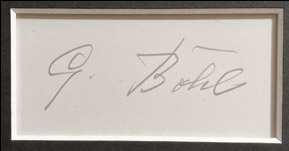 (Gustav Boehl signature included in the mount) |
|
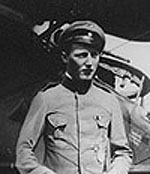
Gustav Boehl Born on 22nd. January 1895, soon after the outbreak of WWI, at the age of nineteen, Gustav Boehl found himself in the German air force stationed at Cambrai in Northern France and working as an airframe and engine mechanic. As the war drew on Boehl eventually managed to obtain a place in pilot training and graduated from flying school in the Spring of 1917. He quickly became commander of 19 Sqdn flying the Albatros, and continued flying combat missions until the end of the war. When hostilities ended he was a highly decorated combat pilot and recipient of the Royal Hohenzollern House Order with Swords. |
||
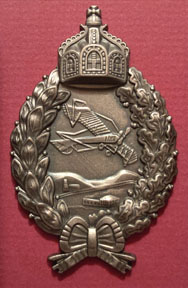 |
Royal Prussion Military Pilot's badge (replica) |