 |
|
Against All Odds
by Robert Taylor
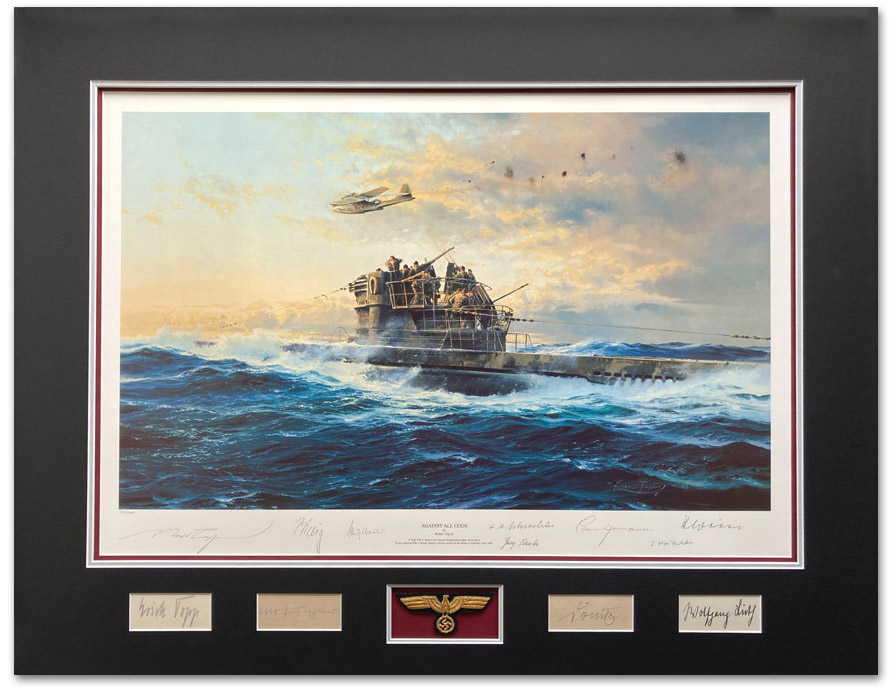
| - featuring four outstanding wartime signatures - Supreme Commander of the U-Boat fleet - Karl Dönitz & the three highest scoring U-Boat commanders of WWII |
| Caught on the surface by a PBY Catalina, the gun crews of a type VIIc U-Boat are quickly into action. The 3.7cm anti-aircraft gun is hurriedly reloaded while on the upper platform the two 2cm anti-aircraft twins take chunks out of the Catalina's tail - enough damage to secure a respite from the attack. Soon they will dive to relative safety beneath the Atlantic swell. This seven signature print has been triple matted to full conservation standards and includes the original wartime autographs of the four most prominent figures associated with the Kriegsmarine's U-Boat arm during WWII. Otto Kretschmer - the most successful U-Boat Captain of the war and the the highest scoring submarine Commander in history, plus the second and third highest scoring U-Boat commanders of the war - Wolfgang Lüth and Erich Topp, plus Supreme Commander of the U-Boat fleet, later Commander-in-Chief of the Kriegsmarine and head of the German State, Grand Admiral Karl Dönitz. Adding further to the historical significance of this piece is the inclusion of an original WWII Kriegsmarine officer's breast eagle. |
| 1 | Museum Presentation | With a total of eleven U-Boat commander and crew signatures & original WWII artifact | SOLD |
| Overall size: 26½" x 34¼" | ll(click for lay-away details) |
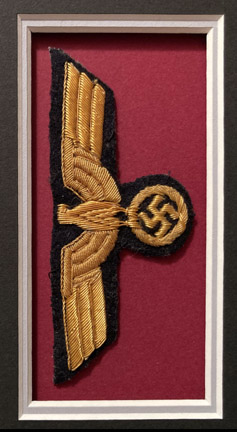 |
Kriegsmarine officer's breast eagle An original WWII hand-embroidered Kriegsmarine officer's breast eagle included in the mount. This example is in outstanding condition, a few traces of thread remain from when it was removed from a uniform but otherwise shows little sign of wear. (click image for larger view) |
|
| The signatures | |
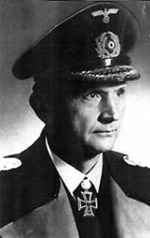 |
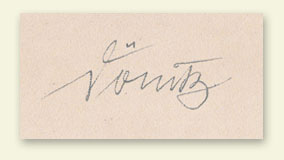
matted wartime signature of Admiral Karl Dönitz |
| Karl Dönitz - Born in 1891, Karl Dönitz began his career in the Imperial German Navy before World War One. On 22 March 1916, Dönitz was promoted to Oberleutnant zur See, he then requested a transfer to the submarine forces, which became effective on 1 October 1916. He attended the submariner's school at Flensburg-Mürwik and passed out on 3 January 1917. He served as watch officer on U-39, and from February 1918 onward as commander of UC-25. On 2 July 1918, he became commander of UB-68, operating in the Mediterranean. It was during this period he began to formulate the concept of U-boats operating in attack groups Rudeltaktik (German for "pack tactic", commonly called a "wolfpack") for greater efficiency, rather than operating independently. On 4 October, after suffering technical difficulties, Dönitz was forced to surface and scuttled his boat. He was captured by the British and incarcerated in the Redmires camp near Sheffield. He remained a prisoner of war until 1919 and in 1920 he returned to Germany. By the start of WWII, Dönitz was supreme commander of the Kriegsmarine's U-boat arm (Befehlshaber der Unterseeboote (BdU)). In January 1943, Dönitz achieved the rank of Großadmiral (grand admiral) and replaced Grand Admiral Erich Raeder as Commander-in-Chief of the Navy. Dönitz was the main enemy of Allied naval forces in the Battle of the Atlantic. From 1939 to 1943 the U-boats fought effectively but lost the initiative from May 1943. Dönitz ordered his submarines into battle until 1945 to relieve the pressure on other branches of the Wehrmacht. 648 U-boats were lost - 429 with no survivors. Furthermore, of these, 215 were lost on their first patrol. Around 30,000 of the 40,000 men who served in U-boats perished. On 30 April 1945, after the suicide of Adolf Hitler and in accordance with his last will and testament, Dönitz was named Hitler's successor as head of state in what became known as the Goebbels cabinet after his second-in-command, Joseph Goebbels, until Goebbels' suicide led to Dönitz's cabinet being reformed into the Flensburg Government instead. On 7 May 1945, he ordered Alfred Jodl, Chief of Operations Staff of the Oberkommando der Wehrmacht (OKW), to sign the German instruments of surrender in Reims, France, formally ending the War in Europe. Dönitz remained as head of state with the titles of President of Germany and Supreme Commander of the Armed Forces until his cabinet was dissolved by the Allied powers on 23 May. |
|
 |
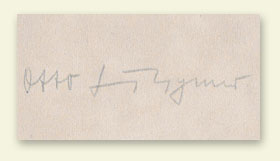 matted wartime signature of Captain Otto Kretschmer |
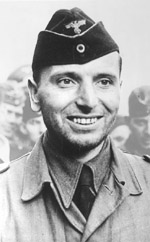
| Otto Kretschmer - Kretschmer entered the Reichsmarine on 1 April 1930, joining the U-boat service of the newly named Kriegsmarine in January 1936. After the completion of his submariner training he was promoted to Oberleutnant zur See (senior-sub lieutenant/Lieutenant Junior Grade) on 1 June. Kretschmer's first operational experience on a submarine was as a lieutenant on the U-35 in 1937 as first watch officer under the command of Hans-Rudolf Rösing. While Kretschmer was discharging his responsibilities for the operational readiness of the deck gun, Rösing dived the boat, leaving Kretschmer stranded in the freezing water. He clung to the periscope in the hope of being seen through the optics. Kretschmer was soon missed and the U-boat surfaced to find him before he succumbed to the cold. On 1 October 1937, Kretschmer took command of U-23. Through the remaining Interwar period, he developed his own approach to combat, which can be summarized by the phrase "one torpedo, one ship". He dispensed with the standard practice of firing salvoes of torpedoes from long distances. The tactics implemented by Kretschmer resulted in a very effective usage of torpedoes, as each attack was designed to maximize the chances of a hit. In fact, out of 116 torpedoes fired in action, Kretschmer scored 74 hits (equivalent to a 69.8% success rate). The vast majority of Kretschmer's attacks - at least 83 - were launched on the surface. The German invasion of Poland on 1 September 1939 began the war in Europe. Karl Dönitz, Befehlshaber der Unterseeboote (BdU), ordered attacks on Allied shipping at sea, beginning the Battle of the Atlantic. From September 1939 until his capture in March 1941 Kretschmer sank 47 ships, including one warship, a total of 274,333 tons. For this he received the Knight's Cross of the Iron Cross with Oak Leaves and Swords, among other awards. He earned the nickname "Silent Otto", both for his successful use of the "silent running" capability of U-boats and for his reluctance to transmit radio messages during patrols. Despite being captured just eighteen months into the conflict, Kretschmer was the most successful U-Boat commander of WWII. |
|
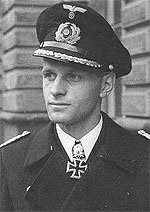 |
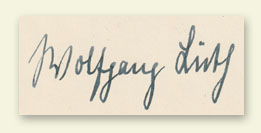
matted wartime signature of Captain Wolfgang Lüth |
Wolfgang Lüth - Lüth joined the Reichsmarine in 1933. After a period of training on surface vessels, he
transferred to the U-boat service in 1936. In December 1939 he received command of U-9, which
he took on six war-patrols. In June 1940 he took command of U-138 for two patrols. In October
1940 he transferred again, this time to the ocean-going submarine U-43 for five war-patrols.
After two patrols on U-181, the second being his longest of the war, he was awarded the Knight's
Cross of the Iron Cross with Oak Leaves, Swords and Diamonds. He was the first of two U-boat
commanders to be so honored during World War II. During his wartime career Lüth was credited with the sinking of 46 merchant ships plus the
French submarine Doris sunk during 15 war patrols, for a total tonnage of 225,204 gross register
tons, making him the second highest scoring U-Boat Ace of WWII. |
|
 |
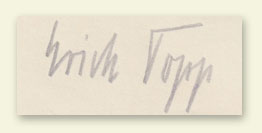 matted wartime signature of Captain Erich Topp |
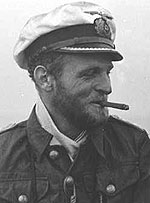
| Erich Topp - Erich Topp began his naval career in April 1934. He served six months on the light cruiser
Karlsruhe before joining the U-boat force in October 1937. A year later he became watch officer
on U-46. After four patrols in U-46, Topp took over command of U-57. During this command he
sank six ships with a total of 36,862 tons - a considerable achievement with a small coastal boat.
U-57 sank on 3 September 1940 after colliding with the Norwegian ship Rona. Topp then commissioned the larger type VIIC U-boat U-552, the famous "Red Devil Boat". Topp scored most of his successes in the North Atlantic against convoys, and off the North American coast. On his very successful eighth patrol in March/April 1942, he sank eight ships with a total of 45,731 tons. In September 1942 Topp became commander of the 27th (Training) Flotilla U-boat Flotilla, where new U-boat crews received their tactical training. Topp wrote the Battle Instructions for the new type XXI Elektro U-boat Elektro Boats in 1944, and when the war ended he was commanding one of them, U-2513, which he surrendered at Horten, Norway in May 1945. Erich Topp was the third highest scoring U-Boat commander of World War II. He was a recipient of the Knight's Cross of the Iron Cross with Oak Leaves and Swords. He sank 35 ships for a total of 197,460 gross register tons. |
|
| All below signed on the print. | |
| Korveitenkapitan Helmut Witte - KC - (commander) | Kapitanleutnant Heinrich Schroeteler - KC - (commander) |
| Kapitanleutnant Heinz Franke - KC - (commander) | Kapitanleutnant Siegfried Koitschka - KC - (commander) |
| Oberbootsmannsmaat Rudolf Muhlbauer - KC - (leading seaman) | Kapitanleutnant Karl-August Landfermann - KC - (engineer) |
| Kapitanleutnant Gerhard Bielig - KC - (engineer) | |