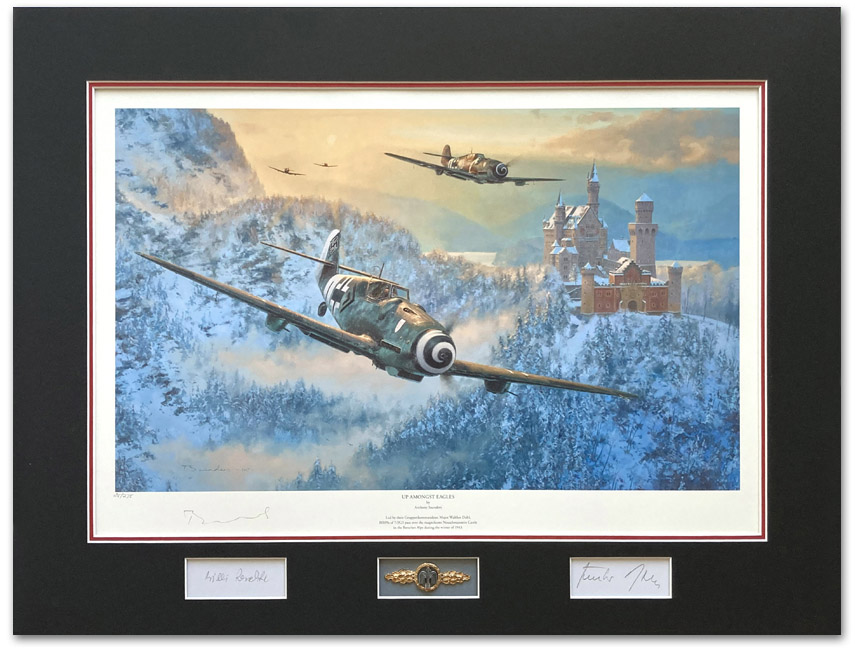
Up Amongst Eagles
by Anthony Saunders
| A magical scene in the Bavarian Alps during the winter of 1943 with Bf109s passing low over the fairytale Neuschwanstein Castle. When the prototype of Willy Messerschmitt's radical all-metal single-seat monoplane fighter first took to the air in May 1935 little did onlookers realise they were witnessing the birth of one of the world’s most iconic aircraft. Sporting sleek lines, a closed cockpit and retractable landing gear the Bf109 was soon wowing the crowds at the 1936 Berlin Olympics, an ominous prelude to its worth in battle after its introduction into service with Germany’s Condor Legion in the Spanish Civil War the following year. It was clear to friend and foe alike that this agile, well-armed little fighter was superior to anything else in the skies and by the outbreak of World War II the Bf109 formed the backbone of Hitler’s new Luftwaffe. With battle-hardened pilots well-prepared for success in Poland, the Low Countries and France, they were now ready to duel with RAF Fighter Command during the Continuously improved and upgraded more Bf109s were produced than any other military aircraft in history, with one exception, the Soviet’s Il-2 Sturmovik. The much-feared fighter was flown by the highest scoring Aces of all time – men such as top-scorer |
| Overall size: 20⅞" x 27½" |
| Archive Presentation | SOLD |
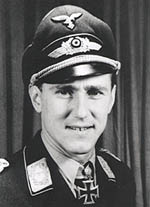 |
Günther Rall Günther Rall was a young pilot with III./JG52 at the outbreak of war, and quickly demonstrated his natural ability and leadership qualities. He scored his first victory early in the Battle of France, and by July 1940 was leading 8./JG52. After transferring to the Eastern Front his victories soon mounted but he was hospitalized following a crash. Returning to combat as Kommandeur of III./JG52, he gained the Wing's 500th victory, before being posted Kommandeur of II./JG11 on the Western Front, flying high altitude intercepts in Me109Gs. He was later Kommandeur of JG300, and finished the war as the 3rd highest scoring Ace in history with 275 victories. He was awarded the Knight ’s Cross with Oak Leaves and Swords. |
|
|
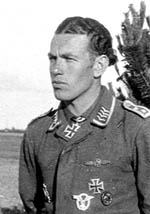 |
Willi Reschke After pilot training, Willi Reschke was transfered to I./JG 302 based at Götzendorf near Wien. On 2 July he achieved his first success when he shot down two B-24s over Budapest. He rammed the next B-24 he downed on 7 July when his guns malfunctioned, he successfully baled out of his stricken aircraft. On 24 August, he claimed a further B-24 Liberator, but shortly after, during an attack on a second, his aircraft was hit by return fire, he baled out when P-51 Mustangs began pouring fire into his Bf 109. After re-equipping with the Focke-Wulf 190 A-8, I./JG 302 was redesignated III./JG 301 on 30 September. In October the unit transfered to Stendal airport near Berlin. On 1 January 1945, Reschke downed a B-17 for his 22nd victory but was again hit by return fire and baled out of his Fw 190 A-8 "White 6". On 13 March, he was awarded the Deutsches Kreuz in Gold. In March he transferred to Stab JG 301. On 14 April, he flew a Ta 152 and claimed an RAF Tempest, later that month he was awarded the Knight's Cross. Willi Reschke flew about 48 combat missions, achieving 27 confirmed victories, 20 of them four-engined bombers. He was shot down 8 times, baling out 4 times, and was wounded once. |
 |