 |
|
Undaunted by Odds
by Robert Taylor
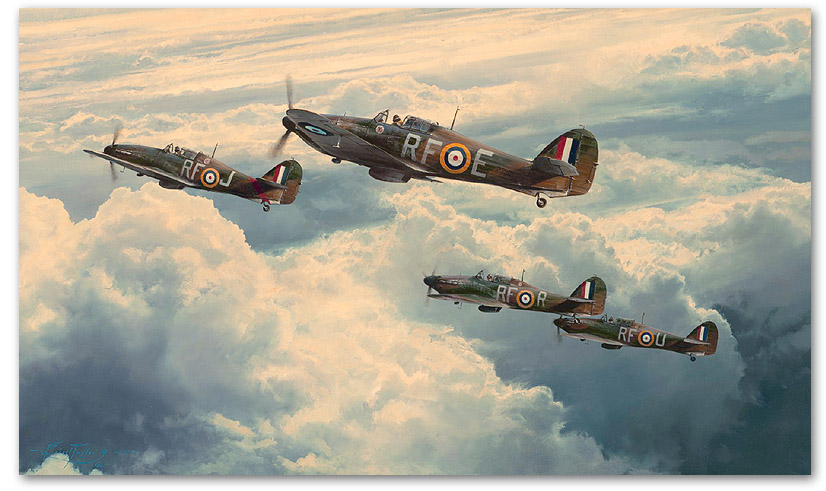
On 6 November 1935, a prototype aircraft took to the air for the very first time. As Sydney Camm’s sturdy, single-engined monoplane fighter climbed into the sky, few realised that it was destined to become one of the enduring symbols of the greatest air battle ever fought. Its name was the Hawker Hurricane. As the prototype Hurricane lifted off that day, it represented the ultimate evolution of conventional airframe technology, constructed using simple metal tubes covered by fabric, methods that had been honed in developing the Hawker Fury, and generations of biplanes before it. It was ‘old fashioned’ but simple and relatively cheap to build and easy to repair. And with the inevitability of war with Germany fast approaching, the RAF not only needed more fighters - it needed them quickly. The Hurricane fitted the bill, and by September 1939 nearly 500 had been delivered to the RAF, far more than the Spitfire. It fought in France and over Dunkirk, but it was during the Battle of Britain that the Hurricane’s ‘finest hour’ was to come. Equipping more front-line squadrons, the Hurricane, although maneuverable, was slower than the Spitfire so the tactics of the battle decreed that the Hurricanes would take on the enemy bombers whilst the Spitfires concentrated on the fast Bf109’s. |
| Overall size: 24" x 35" | Available in the following editions |
| 250 | Limited edition | Signed by three Hurricane pilots who flew with the Polish Squadrons during WWII. | $320 |
| 400 | Hurricane Veterans edition | As above with an additional seven Hurricane pilot signatures. | $365 |
| 25 | Artist's proof | With ten signatures, as above. | $595 |
| 150 | Battle of Britain Tribute ed. | With sixteen pilot signatures, including five on a companion print. | $635 |
| Limited edition signatures | ||
| Squadron Leader Jurek Mencel | Flight Lieutenant Stanislaw Nawarski | Pilot Officer Stefan Ryll |
| Hurricane Veterans edition signatures | ||
| Squadron Leader Jurek Mencel | Flight Lieutenant Stanislaw Nawarski | Pilot Officer Stefan Ryll |
| Flight Lieutenant Jack Biggs | Flying Officer John Byrne | Warrant Officer Eric Carter |
| Flying Officer Ken Cockram | Squadron Leader Frank ‘Dimmy’ Joyce | Flight Lieutenant Hugh Parry |
| Flight Lieutenant Kurt Taussig | ||
| Battle of Britain Tribute edition signatures | ||
| Squadron Leader Jurek Mencel | Flight Lieutenant Stanislaw Nawarski | Pilot Officer Stefan Ryll |
| Flight Lieutenant Jack Biggs | Flying Officer John Byrne | Warrant Officer Eric Carter |
| Flying Officer Ken Cockram | Squadron Leader Frank ‘Dimmy’ Joyce | Flight Lieutenant Hugh Parry |
| Flight Lieutenant Kurt Taussig | Wing Commander Peter Ayerst | Wing Co. Tim Elkington (companion) |
| Wing Co. Bob Foster (companion) | Wing Co. Tom Neil (companion) | Air Cdre John Ellacombe (companion) |
| Wing Co. Tony Pickering (companion) | ||
 |
Deadly Encounter Issued with the Battle of Britain Tribute edition only, the companion print "Deadly Encounter" is signed by five Hurricane pilots who flew during the Battle of Britain. |
| The Signatories |
Squadron Leader Jurek Mencel DFC |
| Flight Lieutenant Stanislaw Nawarski DFC Stanislaw Nawarski originally flew with the French Air Force. He served on Hurricanes during the Battle of France but was shot down in early summer of 1940 just prior to the Battle of Britain. Later joining 302 Polish Squadron, he flew Spitfires on offensive sweeps before D-Day and throughout the subsequent Allied advance through Normandy. |
| Pilot Officer Stefan Ryll AFM Trained as a pilot, Stefan went on to operations with 306 Polish Squadron in 1943, flying both Hurricanes and Spitfires. In April 1944 he then flew Mustangs on bomber escorts, including the final raid of the war in Europe on the famous trip to Hitler’s Eagle’s Nest at Berchtesgaden. |
| Flight Lieutenant Jack Biggs Serving with 17 Squadron flying Hurricanes, he transferred to Spitfires in March 1944 until the end of September 1945 when the squadron was due to provide air cover for the planned invasion on Malaya which, as a result of the atom bomb attacks on Japan, never happened. |
| Flying Officer John Byrne Joining the RAF in 1938, John Byrne flew Hurricanes, Spitfires, P-47s and Tempests before joining 197 Squadron in March 1944. He then flew Typhoons during that squadron’s most hectic period, the run up to D-Day and throughout the subsequent invasion on low-level bombing missions. In total he completed over 150 combat operations and finally left the RAF in 1946. |
| Warrant Officer Eric Carter Initially posted to 615 Squadron, Eric Carter then moved to 81 Squadron flying Hurricanes and was part of Force Benedict, a clandestine operation to defend the strategically vital Russian port of Murmansk. |
| Flying Officer Ken Cockram After training in Rhodesia and a spell with 73 OTU in Egypt, Ken Cockram flew Hurricanes and Spitfires in late 1944 and early 1945 with 26 AA Cooperation Unit based in Egypt. He also flew Curtiss Kittyhawks with 112 Squadron on anti-shipping and fighter patrols, once crashing his aircraft on take-off during a dust storm. He completed a total of 198 operations. |
| Squadron Leader Frank ‘Dimmy’ Joyce MBE Originally flying Hurricanes with 87 Squadron, he was shot down in May 1940 during the Battle of France, was badly injured bailing out and lost his leg. After having a false leg fitted, he returned to active service duties with 286 Squadron, flying Defiants on coastal patrols. |
| Flight Lieutenant Hugh Parry Hugh Parry flew Hurricanes and Spitfires with 260 Squadron, and Typhoons with 266 Squadron. After a spell in Malta with 601 Squadron, and later instructing, he returned to combat flying with 41 Squadron, but was shot down in 1943 and sent to Stalag Luft III. |
| Flight Lieutenant Kurt Taussig In 1939, aged just 15, he was sent by his parents from Czechoslovakia to England to escape the Nazi persecution of the Jews. At 18 he joined the RAF and was posted to 225 Squadron, flying Hurricanes and Spitfires on Tactical and Artillery Reconnaissance duties. |
| Wing Commander Peter Ayerst Peter Ayerst went to France with 73 Squadron flying Hurricanes, where he scored his first victory. During the Battle of Britain he was instructing but shared the destruction of an He111. He later served with 145, 243, 33, 238 and 124 Squadrons on Spitfires and eventually became a test pilot, finishing the war with 9 confirmed victories. |
| Wing Co. Tim Elkington Joining the RAF at the outbreak of war, Tim Elkington flew Hurricanes with 1 Squadron during the Battle of Britain, claiming a Bf109 over the Channel. He later served with 601, 134, 539 and 67 Squadrons. |
| Wing Commander Bob Foster DFC Posted to 605 Squadron, Bob Foster flew Hurricanes throughout the Battle of Britain with great success. In 1942 he went to Australia with 54 Squadron, flying Spitfires from Darwin. He finished the war with 7 victories. |
| Wing Commander Tom Neil Tom Neil flew Hurricanes throughout the Battle of Britain with 249 Squadron and was one of the battle’s finest Aces. In 1941 he served in Malta, before commanding 41 Squadron. Later he was a Flying Liaison Officer with the 100th Fighter Wing, and finished the war with 12 victories. |
| Air Commodore John Ellacombe Flying Hurricanes with 151 Squadron during the Battle of Britain, he shot down a He111 over Hornchurch. A week later he was shot down. He later served with 253 Squadron, then 487 Squadron RNZAF flying Mosquitos. He finished the war with 3 victories. |
| Wing Commander Tony Pickering Tony Pickering flew Hurricanes with 32 and 501 Squadrons during the Battle of Britain, claiming a Bf109, before being posted to 601 Squadron. Later he became test pilot and an instructor. He returned to operations with 131 Squadron. |