 |
|
Strike and Return
by Robert Taylor
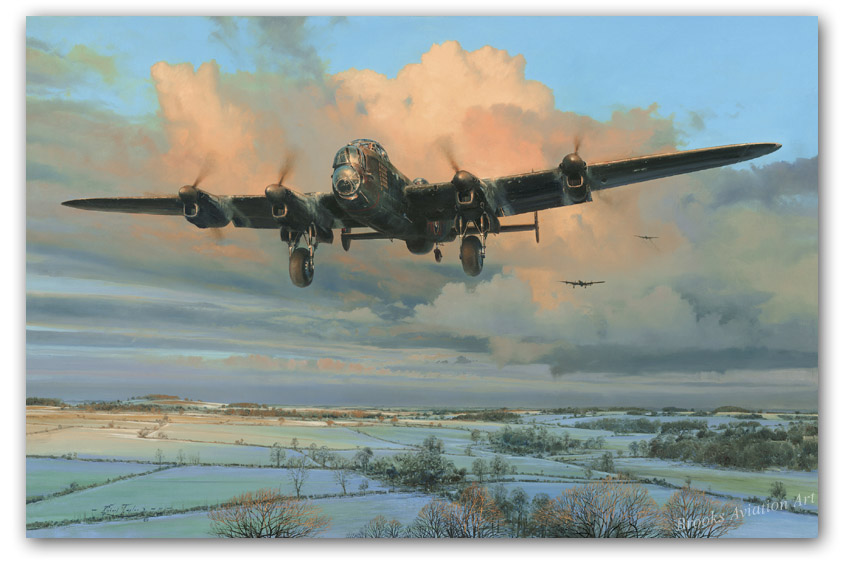
| A tribute to the bomber crews who flew with RAF Bomber Command throughout it's arduous six year campaign. True to their squadron motto “Strike and Return”, Lancasters of 460 Squadron RAAF, return to RAF Binbrook in Lincolnshire following a daylight raid over Germany in the late winter of 1944. |
| Overall size: 24" x 30¾" | Available in the following editions |
| 250 | Collectors edition | Signed by eight Lancaster pilots. Includes companion print signed by Bill Reid VC | $450 |
| Collectors edition signatures | ||
| Pat Cardon | Bob Knights | Tony Iveson |
| Bill North | Dudley Burnside | Lawrence Curtis |
| Ernest Rodley | Fred Watts | |
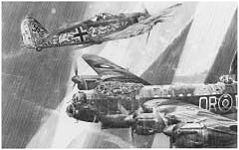 |
Night Attack Piloting a Lancaster on the night of 3 November 1943, Bill Reid was badly wounded during an attack by a German night fighter. Injured in the Injured in the head, shoulders and hands, and with his windscreen shattered, the aircraft crippled and defenceless, he pressed on to the target. Weak, exhausted, and without oxygen he turned for home, steering by the stars to bring his crew safely home. He was awarded the Victoria Cross. Signed by Bill Reid V.C. (Issued with the Collectors edition only) 15" x 20" |
| The Signatories |
| Pat Cardon Pat Cardon joined the RAF in 1932, and qualifying as a pilot served as an instructor at the Central Flying School at Upavon. In 1942 he was released for operations, joining 15 Squadron at Mildenhall for his first tour, flying Lancasters. For his second tour he volunteered for the Pathfinders, and joined firstly 35 Squadron at Gravely on Halifaxes, and then 582 Squadron at Little Staunton, on Lancasters. He finished the war with 66 operations. |
| Bob Knights Joining the RAF in April 1941, after training as a pilot Bob Knights flew Wellingtons, Manchesters, and then Lancasters, joining 619 Squadron at Woodall Spa in 1943. Here he completed 26 operations on his first tour. In January 1944 he was posted to join Cheshire’s 617 Squadron, again at Woodall Spa, where he completed 44 operations, including precision attacks on factories, U-boat and E-boat pens, rocket sites, and three attacks on the Tirpitz. After the war he joined BOAC, and retired in 1975. |
| Tony Iveson Tony Iveson fought in the Battle of Britain with RAF Fighter Command, as a Sergeant pilot, joining 616 Squadron at Kenley flying Spitfires, on 2 September 1940. Commissioned in 1942, Tony then undertook his second tour transferring to RAF Bomber Command, where he eventually was selected to join the famous 617 Squadron, flying Lancasters. He took part in most of 617 Squadron’s high precision and pin-point bombing operations, including all three sorties against the German battleship Tirpitz, and went on to become one of the most respected and prominent pilots in that famous squadron. |
| Bill North Flying Lancasters with 61 Squadron, in 1944 he was shot down over northern France. With his aircraft badly hit, he gave the order to bale out, but as some of the crew had damaged parachutes, he elected to stay with the aircraft and crash-land. Despite being badly wounded, he managed to land his Lancaster at night, and every crewmember walked away – two of them evading capture and returned to England. Bill spent the rest of the war a POW |
| Dudley Burnside Dudley joined the RAF in 1935 and in 1937 went to India flying on the North-West Frontier, and Iraq. At the outbreak of war he went to Burma and in 1942 was fortunate to escape when his airfield was overrun by the Japanese. Escaping back to England he took command of 195 Squadron RCAF flying Wellingtons. In 1943 he became CO of 427 Squadron on Halifax’s, later converting to Lancaster’s. In the Korean War he commanded a Flying Boat Wing operating Sunderlands. He retired from the RAF in 1962. |
| Lawrence Curtis Joining the RAF in 1939, he was posted as a wireless operator firstly to 149 Squadron, and then 99 Squadron on Wellingtons. He then joined OTU on Whitleys before moving firstly to 158 Squadron, and then 617 Squadron on Lancasters, where he was Unit Signals Leader for 18 months. After bomber operations he joined Transport Command in 1944. |
| Ernest Rodley Posted to Bomber Command in 1941, Ernest Rodley joined 97 Squadron flying Manchesters, where in April 1942, he was awarded the DFC following the famous Augsberg daylight raid. After a period at Scampton he was posted back to 97 Squadron, now part of 8 Group Pathfinders. His final command was 128 Squadron flying Mosquitos. He flew 87 operational sorties. |
| Fred Watts Fred Watts joined the RAF in 1940, and qualifying as a pilot was posted to 630 Squadron in 1943 flying Lancasters out of East Kirby. He joined 617 Squadron in 1944 and took part in many of the precision operations that the Squadron was renowned for, including raids on V1 sites, V2 rocket bases, and all three attacks on the Tirpitz. |