|
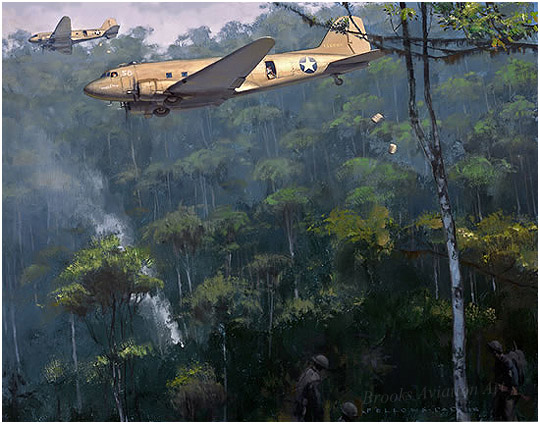
Aerial re-supply was crucial
to aid Australian troops along the infamous Kokoda Trail in thwarting
the Japanese advance across New Guinea's Owen Stanley Mountains,
and was one early example of airlift by Douglas C-47 "Skytrains".
Airlifters moved people and material throughout the vast Pacific
area. In many places, a primary role for fighters and bombers
was to ensure safe passage for the transports. The delivery of
food, fuel, ammunition, and reinforcements often meant the difference
between victory and defeat. Without a comparable airlift capability,
Japanese troops often starved.
In the China-Burma-India Theater,
the "Airlift over the Hump" became the longest sustained
re-supply operation of WWII. An aerial delivery of troops and
supplies in India turned back the Japanese invasion and became
the ultimate victory in Burma. Nowhere was the spirit of American
ingenuity more evident than in the airlift community where, for
example, equipment and vehicles too large for the aircraft were
cut into manageable pieces and flown into the battle area. Paratroop
assaults called for troop carrier airlift and return trips brought
wounded and sick GIs to rear areas for medical attention. Little
was more vital to ground troops or the conduct of the war than
US airlift and troop carrier units.
Signed and numbered by the artist. |