The Sleeping Giant Awakes
by Richard Taylor
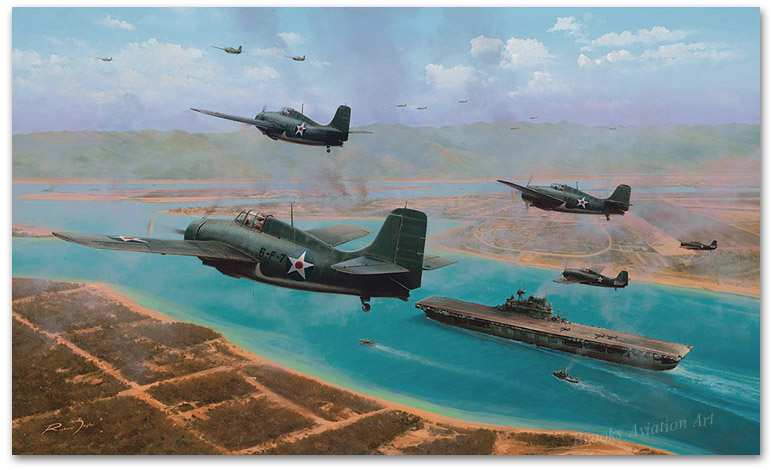
| On Sunday December 7, 1941 the free world had been stunned into disbelief by the treacherous Japanese attack on Pearl Harbor. Giving no formal declaration of war, the devastating Japanese assault on the headquarters of the US Pacific Fleet had left over two thousand American servicemen dead, most of her battleships destroyed or damaged, and the remains of nearly 200 American aircraft lay in tatters. America reeled from the shock and sheer incredulity. But for Admiral Yamamoto, Commander-in-Chief of the Imperial Japanese Navy, and architect of the attack on Pearl Harbor, the success of victory had left a bitter taste. The main targets of his carefully orchestrated plan had been the US carriers but, as fate would have it, they were all at sea. Yamamoto knew in his heart that he would have to face those carriers one day, and when he did they would be the platform upon which America would unleash her full power against him. He commented “I would rather you made your appraisal after seeing what the enemy does, since it is certain that, angered and outraged, he will soon launch a determined counter attack.” He was correct. At 12.30 the following day President Roosevelt began his address to Congress, calling for the declaration of war on Japan. By 4.10pm America was at formally war, and five thousand miles away the first of the carriers, the USS Enterprise, was returning to Pearl Harbor. Richard Taylor’s painting ‘The Sleeping Giant Awakes’ portrays the scene as the Enterprise slips through the shallow outer channels towards Ford Island and the smoldering ruins that had been the Pacific Fleet. As ships still burn and the stench of destruction hangs in the air, ever alert F4F-3A Wildcats of VF-6 fly an air patrol overhead. Throughout the night the carrier will refuel and re-arm, the fires of the still burning Arizona lighting the night sky. At dawn she will return to sea with a steel resolve and a new mission, to avenge Pearl Harbor. |
| Overall size: 21" x 31" | Available in the following editions |
| 350 | Limited edition | Signed by three veterans of the Pearl Harbor raid. | $165 |
| 25 | Artist's proof | As above | $295 |
| The signatures | ||
| Staff Sgt James Anthony Donis USAAC | Sgt Leo Priest US Army | Lt Colonel Bernard Rubien USAAC |
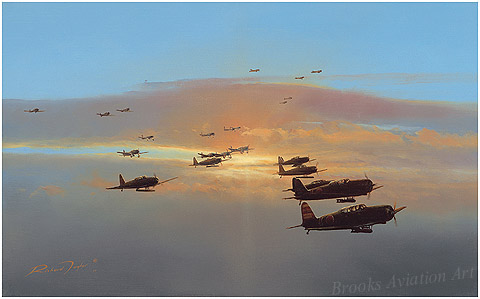 |
Day of the Rising Sun With the rising sun glinting on their fuselages, Nakajima B5N Kate torpedo and high-altitude All editions issued with a matching-numbered, artist signed copy of the companion print 13½" x 18½" |