 |
|
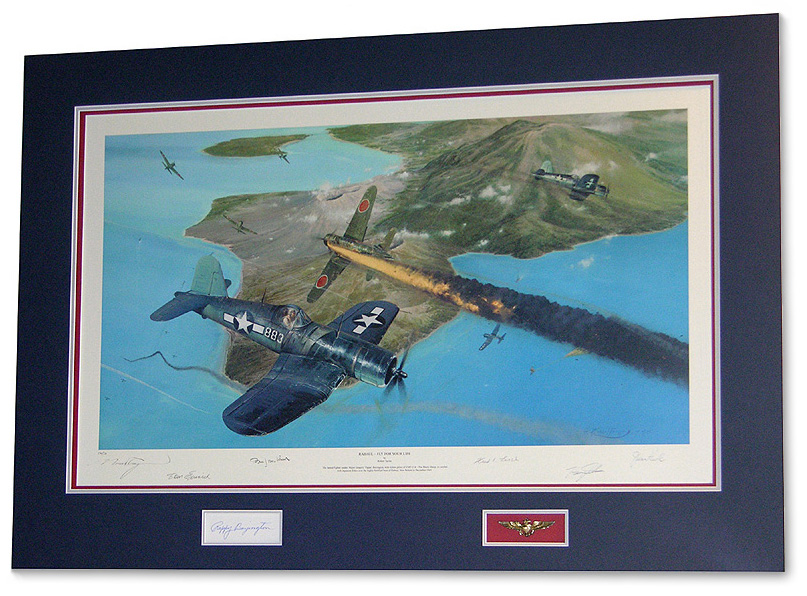
Rabaul - Fly for Your Life
by Robert Taylor
| Includes original Pappy Boyington signature & USMC pilot wings |
| Desperate for new pilots in the South Pacific, in August 1943 the First Marine Wing appointed the unconventional fighter ace Major Greg Boyington to pull together a newly formed squadron from a mix of experienced combat veterans and untested novice pilots. The Marine Corps gave him just four weeks to turn this motley group into a fighting force ready for combat - Boyington succeeded beyond all expectations and the rest is history. Equipped with the Chance Vought F4U Corsair, they called themselves 'The Black Sheep', and under Boyington's leadership, saw action at Guadalcanal, Munda, the northern Solomons,Vella Lavella, Bourganville, and Tokokina;Kahili, and were the first to lead fighter sweeps over the major Japanese base of Rabaul. In a period of just eighty-four days Boyington's pilots recorded 273 Japanese aircraft destroyed or damaged, 97 confirmed air victories producing eight fighter Aces, sank several ships, destroyed many ground installations and numerous other victories. With typical mastery, Robert Taylor has brought to life an encounter over Rabaul in late December 1943, paying tribute to one of the US Marine Corps' most famous fighter squadrons, and its outstanding leader. With the Japanese airbase at Rabaul visible in the distance, 'Pappy' Boyington and his fellow pilots of VMF-214 tear into a large formation of Japanese Zekes and a series of deadly dogfights have started, one Zeke already having fallen victim to their guns. |
| Museum presentation | Signed by five 'Black Sheep' pilots - matted to include the original signature of 'Pappy' Boyington | |
| and original WWII USMC / Navy pilots wings. Also included is a signed companion print. |
| SOLD |
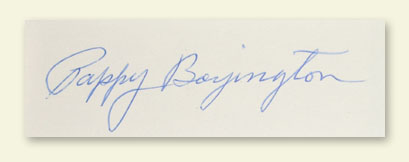
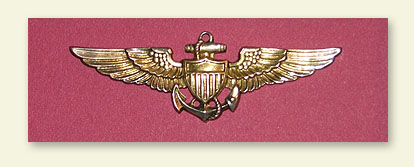
| This 'Black Sheep' edition print has been conservation matted with triple mats and shadow-box layer, to include original signature of the legendary Gregory 'Pappy' Boyington. Also included in the mount are original WWII USMC / Navy pilot wings. (Gold plated Sterling silver) All materials used in the matting meet the highest conservation standards. - Overall mat size: 26¼" x 38" Shipping is free within the continental United States. Note: This item is not available for delivery outside the U.S.A. |
 |
 |
| Signature of Greg 'Pappy' Boyington (click for authentication) |
Original WWII USMC / Navy pilots wings |
| The Signatures |
Boyington began his military training in college as a member of Army ROTC and became a cadet captain. In the spring of 1935, he applied for flight training under the Aviation Cadet Act, but he discovered that it excluded married men. Boyington had grown up as Gregory Hallenbeck, and assumed his stepfather, Ellsworth J. Hallenbeck, was his father. When he obtained a copy of his birth certificate, he learned that his father was actually Charles Boyington, and that his parents had divorced when he was an infant. As there was no record of any Gregory Boyington had ever been married, he enrolled as a U.S. Marine Corps aviation cadet using that name. In February 1936 Boyington was assigned to Naval Air Station, Pensacola, Florida, for flight training. He was designated a Naval Aviator on March 11, 1937, then transferred to Quantico, Virginia, for duty with Aircraft One, Fleet Marine Force. He was discharged from the Marine Corps Reserve on July 1, 1937, in order to accept a second lieutenant's commission in the regular Marine Corps the following day. Boyington resigned his commission in the Marine Corps on August 26, 1941, to accept a position
with the Central Aircraft Manufacturing Company (CAMCO). CAMCO was a civilian firm that
contracted to staff a Special Air Unit to defend China and the Burma Road. This later became
known as the American Volunteer Group, the famed Flying Tigers. During his
time with the Tigers, Boyington became a flight leader. He was frequently in trouble with the
commander of the outfit, Claire Chennault. Boyington was officially credited with 2 Japanese
aircraft destroyed in the air and 1.5 on the ground, but AVG records suggest that he may have
been owed an additional ground "kill". In April 1942, he broke his contract with the AVG and
returned to the United States. In September 1943, he became commanding officer of Marine Fighter Squadron 214, better
known by its nickname, the "Black Sheep Squadron." Boyington received the nickname "Gramps", because at age 31, he was a decade older than most
of the Marines serving under him. The name "Gramps" was later changed to "Pappy". |
| Brig. Gen. Bruce Matheson USMC (main print) Born in Chicago in 1921, Bruce Matheson enlisted in the Marine Corps in 1942 and joined the ‘Black Sheep’ on 7th. August 1943. On 17th. October 1943 he shot down a Zero over Kahili but was wounded during the aerial combat. He safely landed his badly damaged Corsair at Munda. On 3rd. January 1944 Bruce scored his last aerial victory, he also confirmed Major Boyington’s final aerial victory before ‘Pappy’ was shot down near Rabaul. By the end of the second ‘Black Sheep’ tour Bruce would have three confirmed victories and one and a half probables. For his third combat tour he was transferred along with 14 other ‘Black Sheep’ pilots to VMF-211 on Green Island. |
| Major Harry Johnson USMC (main print) Harry Johnson went to the Pacific in November 1943, joining VMF-214 as a replacement pilot. He destryed a Zero in combat on 6th. January 1944, two days before VMF-214 were disbanded. Serving later with VMF-218 and VMF-253, he flew a total of 84 missions on Corsairs during WWII, and another 69 missions in Korea. |
| Lt. Col. W. Thomas Emrich USMC (main print) Thomas Emrich joined VMF-214 on 7th. August 1943, flying two combat tours with them. On 15th. October he shot down two Zeros in aerial combat over Kahili, but the next day, on a fighter sweep, had to ditch off Vella Lavella and be rescued by a PT boat. He flew 68 missions with the ‘Black Sheep’, then a third tour with VMF-211 with other former ‘Black Sheep’ pilots. |
| Lt. Col. James J. Hill USMC (main print) James Hill was born in Chicago in 1920. He arrived in the South Pacific on June 5th 1943 after completing flight school in Pensacola, and joined VMF-214 on 7th. August 1943. He flew two combat tours with the ‘Black Sheep’. On 18th. October 1943 on a fighter sweep over Kahili aerodrome he shot down a Zero in aerial combat. During his tours with the ‘Black Sheep’ he flew a total of 70 combat missions, and flew a third combat tour with VMF-211 on Green Island. |
| Capt. Fred S. Losch USMC (main print) Hailing from Pennsylvania, Fred Losch joined the ‘Black Sheep’ as a replacement pilot on 10th. Nov. 1943. On 2nd. Jan. 1944 he downed a Zero and damaged another over Rabaul. With VMF-214 he flew 28 combat missions, completing a second tour with VMF-211. |
| Lt. Col. Henry M. Bourgeois USMC (companion print) Henry was the youngest ever Marine officer when he joined VMF-214, and had flown two combat tours with VMF-122 prior to that, with two victories to his credit.. On September 21st. 1943 he lead a division of Corsairs to strafe Kahili Aerodrome where he destroyed two aircraft on the ground; the division accounting for 12 aircraft and an AA position destroyed. |
| Col. Edwin A. Harper USMC (companion print) Born in Canada, Ed Harper joined VMF-214 on 7th August 1943 and flew two tours until January 1944, scoring a victory and two probables on sweeps over Kahili and Rabaul. Wounded on 17th October, the next day he flew a mission and scored a probable. Ed was reassigned to VMF-211 for a third tour after VMF-214 were disbanded in January 1944. |
 |
"Black Sheep" companion print signed by Henry Bourgeois & Edwin Harper |
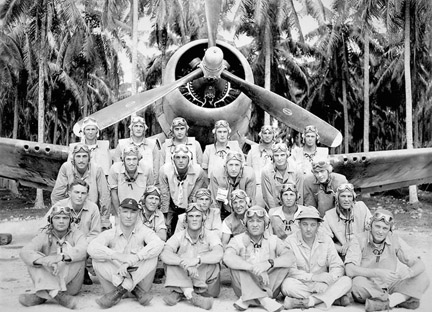 |
| Pappy Boyington with the pilots of VMF-214 - the 'Black Sheep'. |
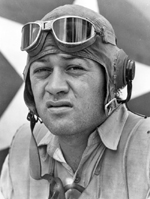 Col.
Col.