 |
|
Open Assault
by Robert Taylor
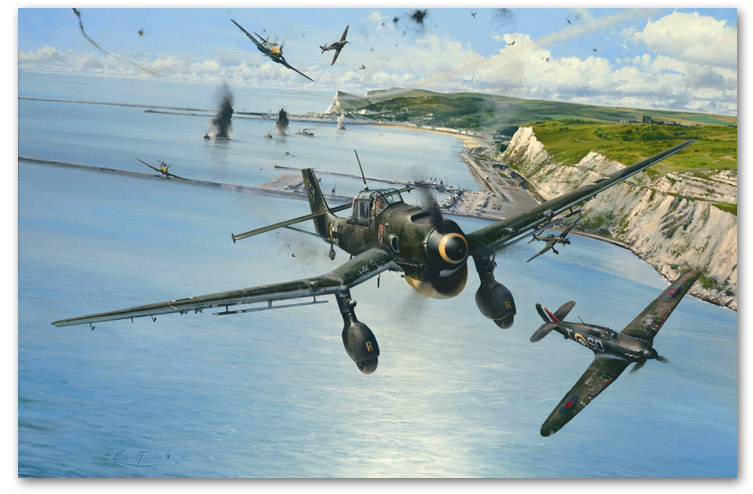
| The Junkers Ju87 Sturzkampfbomber, known to the British simply as the Stuka, had already acquired a deadly reputation across Europe, its siren screaming as the ungainly dive-bomber struck terror into the hearts of those below. In 1940 its pilots crossed the Channel with their grim-looking aircraft to terrorise the southern towns and ports of England. Robert Taylor’s memorable painting ‘Open Assault’, depicts Hurricanes of 501 Squadron attacking a force of Ju87 Stukas as they dive-bomb naval vessels and installations in the port of Dover on 29 July 1940. High explosive bombs detonate within the sheltered anchorage as escorting Bf109s from JG51 race in to protect their lumbering charges. Four Stukas and two Me109s are despatched, for the loss of just one RAF aircraft. |
| Overall size: 25¼" x 33" | Available in the following editions |
| 400 | Limited edition | Signed by one Stuka pilot and two Hurricane pilots. | $320 |
| 250 | Collectors edition | Signed by one Stuka pilot, three Hurricane pilots and two Me109 pilots. | $395 |
| 25 | Collectors edition a/p | Signed by one Stuka pilot, three Hurricane pilots and two Me109 pilots. | $595 |
| 150 | Generals edition | Signed by one Stuka pilot, three Hurricane pilots and four Me109 pilots. | $520 |
| Limited edition signatures | ||
| Leutnant Wilhelm Noller | Grp. Capt. Byron Duckenfield AFC | Wing Co. Tony Pickering |
| Collectors edition signatures | ||
| Leutnant Wilhelm Noller | Grp. Capt. Byron Duckenfield AFC | Wing Co. Tony Pickering |
| Sqdn. Ldr. Douglas Nicholls DFC | Major Eric Rudorffer | Oberleutnant Günther Seeger |
| Generals edition signatures | ||
| Johannes Steinhoff | Günther Rall | |
| Leutnant Wilhelm Noller | Major Eric Rudorffer | Oberleutnant Günther Seeger |
| Grp. Capt. Byron Duckenfield AFC | Wing Co. Tony Pickering | Sqdn. Ldr. Douglas Nicholls DFC |
| The Signatories | |
General Johannes Steinhoff ‘Macky’ Steinhoff’ commanded 4./JG52, and flew throughout the Battle of Britain. In June 1941 he transferred to the East and commanded 11./JG52. He later served in Italy, moving to France after the Normandy invasion. In late 1944 he commanded the first Me262 unit, JG7, before joining Galland’s JV44, where he scored 6 jet victories before being seriously burned in a crash. He had scored 178 victories, and was awarded the Knight’s Cross, with Oak Leaves, and Swords. After the war he rejoined the German Air Force, and in 1966 became Chief of Air Staff. |
|
Generalleutnant Günther Rall Günther Rall was with III./JG52 at the outbreak of war, and scored his first air victory early in the Battle of Britain. By July 1940 he was leading 8./JG52. After transfer to the East his victories quickly mounted, but a crash hospitalised him. Within nine months he was back in action again. |
|
Leutnant Wilhelm Noller Wilhelm Noller joined the Luftwaffe in 1939 and trained as a bomber pilot. In May 1942 he was posted to join 2./StG 2 fighting on the Eastern Front. He took part in the Battles of Kursk and Stalingrad, and became one of the most successful pilots of St.G.2. By early 1943 his combat mission total passed the 500 mark, rising to over 800 by the end of the year. He was awarded the Knight’s Cross in April 1944, a few weeks after passing the 1000 mission mark. After a period instructing, he returned to combat in February 1945, flying the Fw190 with 7./SG. 10 in Czechoslovakia. Wounded in April 1945, and hospitalised in Prague, he was taken prisoner by the Soviets when they took over the city in May. Transported east by rail towards Russia, he jumped from the moving train and escaped back to Germany. During the war he had flown 1058 missions, destroyed 86 tanks, 2 armoured trains, plus many vehicles, boats and bridges. He also gained 2 victories in aerial combat. |
|
| Major Eric Rudorffer Erich Rudorffer joined I./JG2 ‘Richthofen’ in November 1939, and was soon flying combat patrols. He took part in the Battle of France, and the Battle of Britain, becoming Adjutant of II./JG2 in June 1941. In December 1942 he was transferred to North Africa, and in July 1943 he was posted to command II./JG54 in Russia. In February 1945 he took command of I./JG7 flying the Me262. Erich Rudorffer was the master of multiple scoring – scoring more multiple victories than any other fighter pilot. This included 8 RAF aircraft in 32 minutes in December 1943, and 7 in 20 minutes a few days later. In Russia he shot down 5 aircraft in only 4 minutes. He ended the war with 222 victories from over 1000 combat missions. He was awarded the Knight’s Cross with Oak Leaves and Swords. |
|
Oberleutnant Günther Seeger |
|
| Group Captain Byron Duckenfield AFC Byron Duckenfield joined 74 Squadron at Hornchurch in April 1940, flying Spitfires, and on 22 July was posted to 501 Squadron flying Hurricanes first at Middle Wallop, then to Gravesend, scoring his first victory, a Ju87, on the 29th. During August and September he scored three more victories. After a spell instructing, he was posted to command 66 Squadron, and in February 1942 to command 615 Squadron, which he took to the Far East. In late December 1942 he was shot down in Burma and captured by the Japanese. He remained a POW until release in May 1945. |
|
| Wing Commander Tony Pickering With the RAFVR just before the war commenced. Tony Pickering joined 32 Squadron at Biggin Hill in July 1940, flying Hurricanes; and in August 1940 went to 501 Squadron at Gravesend. In September he was shot down unhurt in a duel with a Me109, destroying another 109 a few weeks later. In December he joined 601 Squadron at Northolt. After a spell instructing, he joined 131 as a Flight Commander in February 1943, and later served as a Squadron Commander in the Middle East. |
|
| Squadron Leader Douglas Nicholls DFC |