 |
|
Narrow Escape
by Heinz Krebs
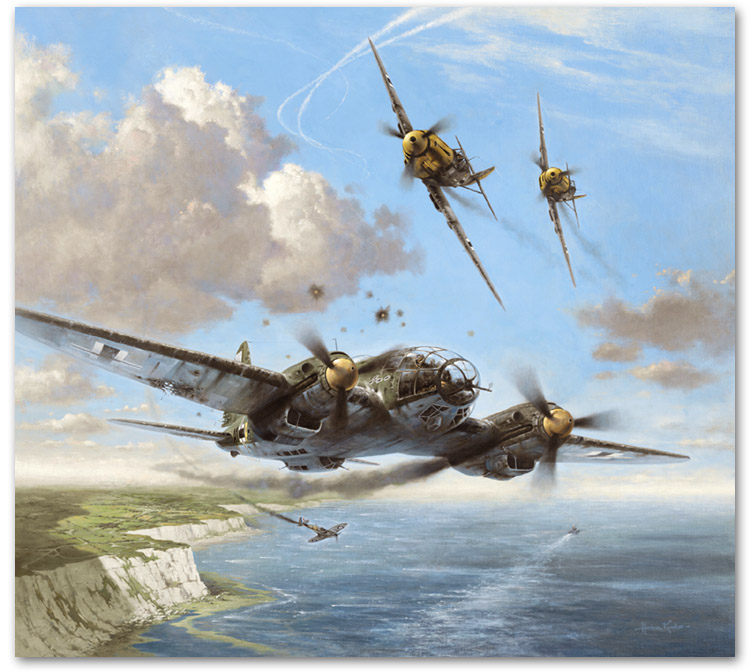
| It is the late summer of 1940, and the Battle of Britain is at it’s height. Racing for the coast, following a bombing mission over southern England, a straggling He111 of KG55 has been attacked by a Spitfire of RAF Fighter Command. The bomber is badly damaged, but in the nick of time a pair of Me109s of JG26 have come to the rescue, sending the Spitfire diving into the Channel. If they are lucky the Heinkel crew may still make it back to their base in France. |
| Overall size: 26½" x 27" | Available in the following editions |
| 350 | Ltd. edition | Signed by two Me 109 Aces and three He111 pilots | $195 |
 |
Receive your print fully framed and ready to display. Please call or email us for a custom framing quote. |
| The signatures | ||
| Hugo Dahmer | Otto Schultz | Hajo Hermann |
| Heinrich Suedel | Hans Kirn |
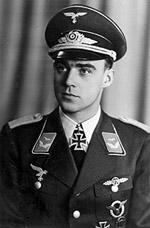 |
Hugo Dahmer Hugo Dahmer was born on 7 May 1918 at Koblenz. Dahmer initially served with 4./JG 26. Unteroffizier Dahmer recorded his first victory on 16 May 1940 when he shot down aFrench Morane 406 over Tournai. In August, he transferred to 6./JG 26. He performed well during the Battle of Britain taking his score to nine by the end of September 1940. On 1 February 1941, Dahmer was transferred to 1./JG 77 based in Norway. He flew with the unit during the invasion of Russia, claiming 11 victories during the first three weeks of the campaign. In March 1942, 1./JG 77 was redesignated 6./JG 5. Oberfeldwebel Dahmer was awarded the Ritterkreuz on 30 July for 22 victories. Following a brief spell as a fighter pilot instructor, Feldwebel Dahmer rejoined JG 26 based on the Channel front in December 1942 but transferred to JG 2 a few weeks later. He recorded his 39th victory in January 1943 and, at the beginning of March, shot down two USAAF B-17 four-engined bombers in one mission over Brittany in France. Dahmer was appointed Staffelkapitän of 1./JG 2 on 17 August 1943. On 11 September, he was badly wounded in combat with RAF Spitfires near Rouen and spent the rest of the war instructing at fighter schools. Hugo Dahmer was credited with 45 victories in 307 missions although some sources quote his score as 57. |
 |
Otto Schultz
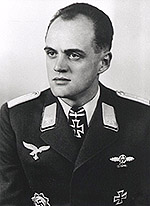
Born May 31st, 1920 in Dannenberg, Germany. One of the proverbial German "Experten" who managed to survive five years of air combat by his skill and experience. Joined 4./JG51 stationed near the English Channel in the autumn of 1940. 40th victory in Tunesia during the Africa campaign on December 4th, 1942. Awarded the Knight's Cross after his 53rd aerial victory. Shot down and seriously injured by P-51 near Sofia, Bulgaria on June 28th, 1944. Re-joined II./JG51 as this unit's leader on December 24th, 1944 and won five more victories before the war ended. |
 |
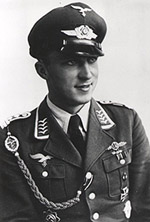
Hajo Hermann
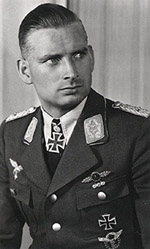
Born 1 August 1913 in Kiel, Germany. He was one of the Luftwaffe's most innovative air tacticians during WWII. Beginning his military career as an infantry officer, he was commissioned in the newly formed Luftwaffe in 1935. From 1936 til 1937 he was a bomber pilot of the Condor Legion, which was responsible for the almost complete destruction of the Basque town of Guernica during the Spanish civil war, joined KG-4, and wrote several well received tactical reports. When WWII began, he flew Heinkel He-111's in Poland and Norway. By 1940 Hermann was Commander of the 7th Staffel of KG-4, and led many attacks on England during the Battle of Britain. In February of 1941 his group went to Sicily, where they flew against Malta and Greece. In one such attack, he dropped a single bomb on an ammunition ship. The resulting explosion sank 11 ships and made the Greek port of Piraeus unusable for many months. In early 1942 he was Commander of III/KG30, attacking arctic convoys from Norway, including the |
 |
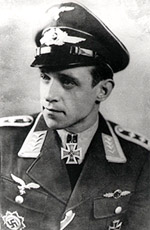
Heinrich Suedel
Born April 23rd, 1920 in Wellspang, Germany. Flew in France during the early period of WWII. Took part in the entire Battle of Britain as a pilot in Kampfgeschwader 55 (KG 55) until the spring of 1941. Then posted to the Eastern Front, where he spent nearly all of his remaining flying time in WWII including many missions over Russia. Took part in the Stalingrad and Caucasus campaigns. 408 combat missions, nearly all of them in the Heinkel He 111. Conversion training to the Me 262 jet near the end of the war. |
 |
Hans Kirn
Born August 8th, 1920 in Lindau, Germany. Joined the National Socialist Flying Corps NSFK on April 1st, 1939. Kirn started his basic military and flight training on October 14th, 1939 and graduated from Flugzeugführerschule Magdeburg on September 30th, 1940. Posted to Flugzeugführerschule Prague Rusin, then on to Blindflugschule (instrument flight training school) Strassburg until December 1941. |