Brooks Aviation Art 

click on image for detail


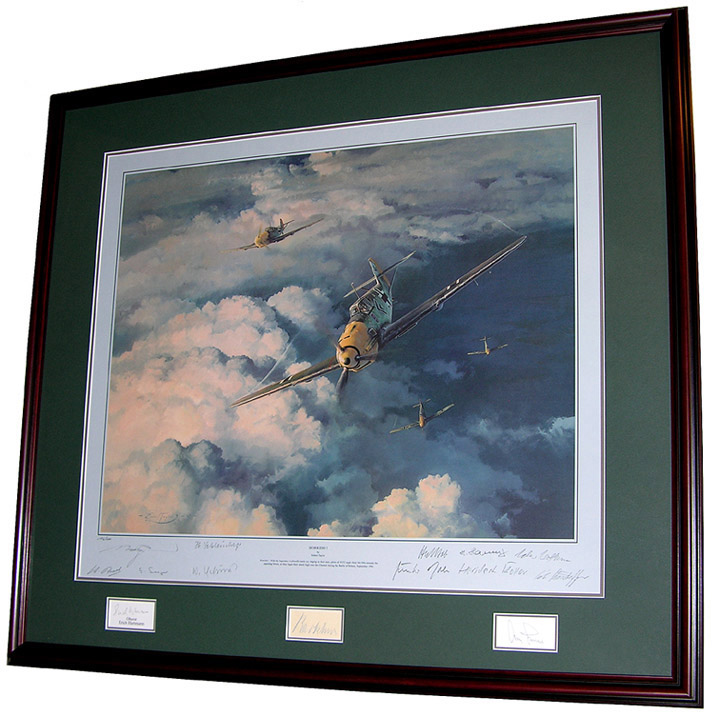
Horrido!

by Robert Taylor


Of the many outstanding Luftwaffe fighter wings of World War Two, JG-52 was the most successful. Many of the most famous Aces flew with this wing, including one-time squadron commander Adolf Galland, and the two highest scoring fighter pilots in history, Erich Hartmann and Gerhard Barkhorn.
Here we see the aircraft of squadron commander Wolfgang Ewald high above the English Channel as he leads pilots of I./JG52 into combat during the Battle of Britain.
The print is signed by ten Luftwaffe figher Aces, and conservation framed to include the authentic original wartime signatures of Erich Hartmann, Gerhard Barkhorn and Werner Mölders.

Overall frame size: 32" x 35¼"

$2,750


All materials used in the matting are acid free, and the print has been mounted using conservation grade mounting corners, glazing is scratch-resistant ultraviolet filtering plexiglass. The frame moulding is a deep mahogany colour with black beaded edge. For clarity, the piece was photographed before the installation of the plexiglass.

Shipping is free within the continental United States. For other delivery addresses please call or e-mail for quote. Please feel free to call us with any questions you might have regarding this piece.


home Robert Taylor

e-mail  Featured Artists


The signatories
Oberst Erich Hartmann (matted)

Erich “Bubi” Hartmann was born on 19 April 1921 at Weissach in Württemberg, he learned to fly sailplanes and had gained his pilot’s licence in 1939. He entered the Luftwaffe on 10 October 1940. His first operational posting was to 7./JG 52 on the Eastern Front on 10 October 1942. Leutnant Hartmann came under the guidance of Oberfeldwebel Edmund “Paule” Rossmann , considered one of the best element leaders on the Eastern Front. During this time he was given the advice of several other accomplished aces of 7./JG 52, including Oberfeldwebel Alfred Grislawski and Leutnant Walter Krupinski.
Hartmann recorded his first victory, a Russian Il-2 Sturmovik ground-attack aircraft, shot down on 5 November 1942. However, he too was hit in the engagement and was forced to crashland. By the end of April 1943, his victory total stood at 11. On 23 May he claimed his 17th victory but two days later force-landed his Bf 109 G-4 “White 2” after colliding with a LaGG-3 fighter.
By the end of August 20th 1943 his victory total had reached 90, however, he was shot down, and captured, but was able to escape and returned to his unit after two days.
On 2 September 1943, Hartmann was appointed Staffelkapitän of 9./JG 52, and gained his 100th victory on 20 September 1943. He recorded his 150th victory on 13 December, and reached his 200th victory on the 26 February 1944, on a day when he shot down 10 Airacobra fighters.
For a short period, Hartmann operated over Rumania intercepting the American daylight bombing raids on the Rumanian oil fields and installations,
and on 24 June he claimed a 15th USAAF P-51 fighter as his 265th victory. He became the first fighter pilot to record 300 victories on 24 August 1944, on a day when he shot down eleven enemy aircraft. Hartmann was awarded the Brillanten for 303 victories on 25 August 1944, only the 18th German soldier to receive this accolade. He was immediately prohibited from combat flying and was assigned to Erprobungskommando 262 to test fly the Me 262 jet fighter.
In October, Hartman was able get the prohibition on his combat flying lifted. On 1 October he was appointed Staffelkapitän of 4./JG 52 (or 7./JG 52?) based in Hungary. In mid-February 1945, Hartmann was given command of I./JG 52. In March he was transferred to Lechfeld for short training on the Me 262 jet fighter before requesting to return to JG 52. He became the only man ever to achieve 350 victories on 17 April 1945 and in late April he was promoted to Major. On 8 May 1945 he claimed his 352nd, and last, victory against a Yak-9 fighter over the Brünn area in Czechoslovakia. Major Hartmann surrendered his unit to an American armoured unit but on 24 May, but he was handed over to the Russians. He was to be sentenced to 25 years hard labour by the Russians, serving 10 years before returning to Germany on 15 October 1955. He served in the reformed Luftwaffe from 1956 and commanded JG 71. He retired from active duty in 1970. Erich Hartmann died on 19 September 1993 at Weil im Schönbuch.
Major Gerhard Barkhorn (matted)

Gerhard Barkhorn was born on 20 May 1919 at Königsberg in East Prussia. He joined the Luftwaffe in 1937 as a Fahnenjunker. He began his flying training in March 1938 in the pre-war Luftwaffe. On completion of his training he was posted to 3./JG 2. On 1 August 1940 Leutnant Barkhorn was transferred to 6./JG 52 based on the Channel Front. He flew his initial missions with his new unit during the Battle of Britain but did not confirm any victories during this time. He was, however, shot down into the Channel on one occasion but was rescued unhurt. Barkhorn achieved his first success during his 120th mission on 2 July 1941 over the Eastern Front. Thereafter he was to score steadily, if relatively unspectacularly in comparison to other Eastern Front Luftwaffe aces, achieving his 10th victory on 30 November 1941. On 21 May, Barkhorn was appointed Staffelkapitän of 4./JG 52. Barkhorn was not a prolific scorer; his best single mission netted him four victories, his best day seven victories. In May he recorded seven victories, 16 victories in June and 31 in July, including six on 19 July for his 46th through 51st victories, and five on 20 July (52-56). On 25 July, he was wounded in combat flying Bf 109 F-4 (W.Nr. 13 388) “White 5”. Oberleutnant Barkhorn was awarded the Ritterkreuz on 23 August 1942 for 64 victories. After a two-month break away from the front he returned in early October. He recorded 14 victories in October, seven in November and 17 in December, including his 100th victory on 19 December. On 11 January 1943, he was awarded the Eichenlaub (Nr 175) when he achieved his 105th victory.
Hauptmann Barkhorn became Gruppenkommandeur of II./JG 52 on 1 September 1943, and led it until 15 January 1945. He claimed 24 victories in August, including his 150th on 8 August. He claimed 15 victories in September, 23 in November, including his 200th victory on 30 November 1943, and 28 in December, including seven on 28 December (216-222). On 23 January 1944, Barkhorn became the first fighter pilot to have completed 1,000 combat missions. He achieved his 250th victory on 12 February, the second to do so. He was awarded the Schwertern on 2 March 1944 for 251 victories. Barkhorn’s success had not come without some cost. He was shot down nine times in his combat career. He baled out once and was wounded twice. On 31 May 1944, Barkhorn was flying his sixth mission of the day and, being fatigued, was not concentrating on keeping a good look-out when he was bounced by a Russian Airacobra fighter and shot down. He received severe wounds to his right arm and leg which put him out of action for four months. He returned to combat duty at the end of October. He claimed his 275th victim on 14 November. He recorded his 301st, and last, victory on 5 January 1945.
Gerhard Barkhorn died on 8th. January 1983.
 
Oberst Werner Mölders (matted)

Werner "Vati" Mölders was born on 18 March 1913. He joined the army in 1931 and served as an officer cadet in the Infantry. In 1934, with the rebirth of the Luftwaffe, Mölders requested a transfer to become a pilot. At his first attempt to join the Luftwaffe, he was declared unfit for flying. He tried again and was accepted for flying training. He was badly afflicted by air sickness but overcame the problem through sheer willpower. On 1 July 1935, Leutnant Mölders was posted to Fliegergruppe Schwerin (later to be redesignated I./StG 162). He was appointed Staffelkapitän of 1./JG 334 (later to be redesignated 1./JG 53) on 15 March 1936. On 1 April 1936, he was transferred to the Schulstaffel of JG 134 to undertake instructing duties. For two years he was an instructor at Wiesbaden. He volunteered for the Condor Legion and arrived by sea in Cadiz on 14 April that year, taking over from Adolf Galland at the head of 3.J/88. During the Spanish conflict he showed considerable qualities not only as a pilot and marksman but also, and especially, as a tactician and organiser. Together with other airmen, in Spain he developed the technique known as the "finger four", or fan, which improved a flight's all-round vision and encouraged the pilots' initiative. Between 15 July and 3 November 1938, he shot down fourteen aircraft, and was awarded the Spanienkreuz in Gold mit Schwertern und Brillanten in recognition of his achievements. At the end of the year he returned to Germany as the highest scoring German pilot of the Spanish conflict.
At the beginning of World War II, Mölders was Staffelkapitän of 1./JG 53 , based at Wiesbaden-Erbenheim. He became known by those under his command as "Vati" (Daddy) Mölders. He shot down his first aircraft of the Second World War on 21 September 1939, a French Curtiss 75 A fighter. On 1 November he went on to command III./JG 53, also based at Wiesbaden-Erbenheim. On 27 May 1940, after his 20th victory he was promoted to Hauptmann and decorated with the Knight's Cross. He was shot down in combat on 5 June 1940, by French ace Sous Lieutenant René Pommier Layragues after having scored 25 victories during 128 missions and was taken prisoner. He was liberated two weeks later upon the armistice with France. He returned to Germany to be promoted to Major and given command of JG 51 as Kommodore. On 28 July 1940, during his first flight with his new unit, he succeeded in downing a Spitfire, but his aircraft was then hit by the enemy aircraft. Severely wounded in the legs, Mölders just managed to make an emergency landing at the airfield at Wissant in France. It was not until a month later that he was able to return to combat. He quickly brought his score up by downing 28 British fighters during the remainder of the Battle of Britain, including his 40th, a Spitfire over Dungeness, on 20 September, for which he was awarded the Oak Leaves (No. 2) the next day. On 22 October he downed three RAF Hurricanes to become the first Luftwaffe pilot to reach a score of 50 aerial victories. By the end of the Battle of Britain he had a total of 54 victories, and he would add one more before the end of the year.

He continued flying and fighting over the Channel Front until early May, by which time he had brought down an additional 13 British aircraft. On 22 June 1941, the first day of Operation Barbarossa on the Eastern Front, he shot down four Russian aircraft. He was the first pilot to surpass von Richthofen's WW I record score of 80 on 30 June, and on 15 July he became the first pilot in history to record 100 victories and was immediately awarded the Brillanten, the first German soldier to be so recognized. He was immediately forbidden to fly combat on the personal orders of Göring. At only 28 years of age, he was promoted to Oberst and appointed Inspector General of Fighters on 7 August. Even though ordered to cease flying combat missions, he continued to do so and achieved several unconfirmed victories over the Crimea. He personally instructed many pilots on how to achieve success, and helped develop the forward air controller concept. On 22 November 1941, he was flying as a passenger in an He111 from the Crimea to Germany to attend the funeral of Ernst Udet. Landing during a thunderstorm at Breslau the aircraft crashed and Mölders and the pilot were killed. In his memory, on 20 December 1941, JG 51 was bestowed the honor name "Mölders".
He flew a total of some 330 missions during the Second World War, 100 of these on the Eastern Front, during which he shot down a total of 101 aircraft, 33 of these in the East. He also was the top scorer of the Legion Condor in Spain with 14 victories achieved in some 100 missions, and helped develop many of the modern fighter tactics still in use today.
 
Generalleutnant Günther Rall

Günther Rall was a young pilot with III./JG52 at the outbreak of war, and quickly demonstrated his natural ability and leadership qualities. He scored his first victory early in the Battle of France, and by July 1940 was leading 8./JG52. After transferring to the Eastern Front his victories soon mounted but he was hospitalized following a crash. Returning to combat as Kommandeur of III./JG52, he gained the Wing's 500th victory, before being posted Kommandeur of II./JG11 on the Western Front, flying high altitude intercepts in Me109Gs. He was later Kommandeur of JG300, and finished the war as the 3rd highest Ace in history with 275 victories.
He was awarded the Knight ’s Cross with Oak Leaves and Swords.


Major Erich Rudorffer

Erich Rudorffer joine I./JG52 'Richthofen' in November 1939, and was soon flying combat patrols. He took part in the Battle of France, and the Battle of Britain, becoming Adjutant of II./JG2 in June 1941. In December 1942 he was transferred to North Africa, In July 1943 he was posted to command II./JG54 in Russia. In February 1945 he took command of I./JG7 flying the Me262. Rudorffer was the master of multiple scorin - scoring more multiple victories than any other pilot. These included 8 RAF aircraft shot down in 32 minutes in December 1943, and 7 in 20 minutes a few days later. In Russia he shot down 5 aircraft in only 4 minutes. He ended the war with 222 victories in over 1000 combat missions. He was awarded the Knights Cross with Oak Leaves and Swords.
*

 
First Leutnant Walter Schuck

By April 1943 Walte Schuck had collected 54 victories, and in June chalked up his 100th victory during a day when he shot down six aircraft, making him the leading pilot on the Arctic Front. He commanded JG5 before transferring to fly the Me262 as Staffelkapitän of 3./JG7, where he shot down 8 aircraft, his final tally was 206 victories. He was awarded the Knights Cross with Oak Leaves.
 
Leutnant Hugo Broch 

Vital to all fighter units are the pilots who make such superb wingmen that their their leaders are loath to part with them. Hugo Broch was one such pilot. Having joined JG54 in January 1943 he flew first with Horst Adameit (166 victories) and later with 'Bazi' Sterr (130 victories), but soon demonstrated his own skill in combat. By the end of 1944 he had attained a score of 71 victories. One of JG54's great Fw190 Aces, Hugo Broch saw combat on the Eastern and Baltic fronts, and completed the war having flown 324 combat missions, claiming 81 victories. He was awarded the Knights Cross.
 
Major Hans-Ekkehard Bob 

Flying with JG54 at the beginning of the war, Hans-Ekkehard Bob saw action in the Polish and French campaigns before being appointed Staffelkapitän of the 9th Staffel during the Battle of Britain. In June 1943 he was promoted Kommandeur of IV./JG51 and in May 1944 Kommandeur of II./JG3 until August 1944. At the end of the war he was adjutant of JG44, Galland's Squadron of Experts, where he also flew the Fw190D at Ainring airfield. During the war he flew over 700 combat missions and scored 60 victories. He was awarded the Knights Cross.
 
Leutnant Norbet Hanig

Norbet Hannig began operations with JG54 on the Eastern front near Lenningrad in early 1943, flyinf first the Messerschmitt Bf109G, later converting to the Fw190. He became a Staffelkapitän with JG54, notching up an impressive 42 victories. Towards the end of the war, in early 1945, he converted to the Me262 and flew in combat with III./JG7.
 
Feldwebel Herbert Koller

Posted to II./JG54 on the Eastern Front, Herbert Koller flew Fw190s with 5./JG54, scoring his first victory on 19th February 1943, over an Il-2. By the end of the year his victory claims had reached 12. The year 1944 saw intense combat for 5./JG54 on an almost daily basis, and month by month Herbert Koller's victories continued to mount, by the end of 1944 his tally had risen to 48. His final, and 49th victory was achieved on 9th April 1945 when he downed a Yak 3.
 
Oberleutnant Walter Wolfrum

Born May 23 1923 in Schmölz. Walter Wolfrum first saw combat in the Crimea with 5./JG52. He was shot down three times, and wounded twice before scoring his first victory. With his score at 70, he was again wounded, but returned to take command of I./JG52 in May 1944. He was again wounded but returned to his command for the remainder of the war. He flew 424 missions and achieved 137 victories. He was awarded the Knights Cross.
 
Oberleutnant Günther Seeger

In February 1940, Günther Seeger was an Unteroffizier with 3./JG2, scoring his first victory in the early days of the Battle of Britain. He served on the Channel Front until December 1942, including several months with the Geschwaderstabsschwarm. He transferred to the Mediterranean theatre with II./JG2 before joining 6./JG53. In February 1943 he joined 7./JG53, becoming Staffelkapitän in September 1944. Awarded the Knights Cross, Günther Seeger flew over 500 combat missions and scored 56 victories, all of them in the west.
 
Leutnant Hermann Schleinhege

Born in 1916, Hermann Schleinhege joined I./JG3 as an Unteroffizier in 1941 before being posted to join II./JG54 'Green Hearts' in May 1942. He then flew continuously with JG54 through to the end of the war, by which time he was Staffelkapitän of 8./JG54. Flying a total of 484 combat missions, by the end of the war he had reached a total of 98 victories. He was awarded the Knights Cross.


home Robert Taylor

e-mail  Featured Artists