Brooks Aviation Art  Heinz Krebs   home page Featured Artists  Aircraft Search

click on image for detail view


The Forge
by Heinz Krebs


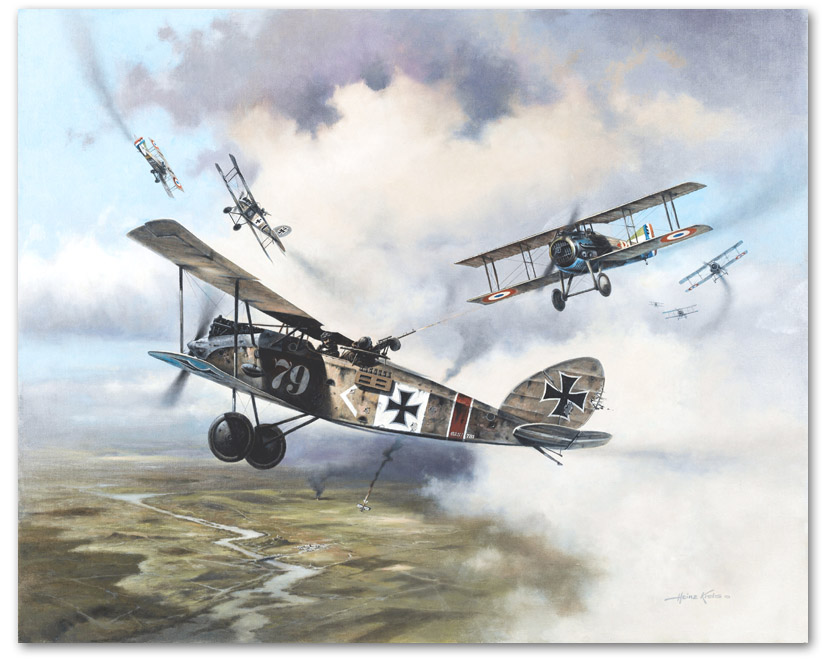
High above the trenches on the Western Front, German aviator Gustav Boehl and his gunner are engaged in mortal combat as their Halberstadt CL IV comes under attack from French Spads.
It's the dawn of a new age in military history, and a new weapon is being forged, the aerial force.

The original oil painting of this piece is currently available.
24¼" x 27"

Available in the following editions

325 Standard edition Signed by the artist $150
50 Artist's proof Signed by the artist $225
25  Publisher's proof  Signed by the artist  $295 
100  Gold edition  Signed by the artist and matted to include the signature of Gustav Boehl. * $400  

*A shipping charge of $25 applies to the Gold edition , for overseas deliveries please call or email for quote.


Gold Edition - Overall size: 29¼" x 32¾"

Gustav Boehl

In the late stages of World War One German military commanders recognized a growing necessity for the close protection of reconnaissance and artillery control aircraft. As a result the so-called "Schutzstaffeln" (protection units) came into being

The typical aircraft model used by such units were "C" type aircraft which were subsequently replaced by lighter machines known as "CL" type aeroplanes. Popular manufacturers of CL types were the "Hannoversche Waggonfabrik" and the "Halberstaedter Flugzeugwerke" as well as, later in the war, the Junkers aircraft company.

Although aircraft made by the "Hannoversche Waggonfabrik" were designed by German aviation pioneer Claude Dornier, they weren't near as popular with German combat crews as the aircraft made by the "Halberstaedter Flugzeugwerke". Due to their agility and speed, their airplanes, only slightly larger dimensioned than single seat fighters, were especially well suited for use with the "Schutzstaffeln".

On October 13th, 1917 Gustav Boehl, whose original signature is included with each piece in the gold edition of "The Forge" was verifiably transferred from the military flight training unit "Armeeflugpark 4" to the front line unit "Schutzstaffel 19", where he served as a combat pilot in the rank of a Sergeant. "Schutzstaffel 19" was renamed "Schlachtstaffel 19" (Schlasta 19)
on March 27th, 1918. The "Schlachtstaffeln" are commonly regarded as the forerunner of the fighter bomber units in later years of military aviation history.

In the spring of 1918 such a "Schlachtstaffel" would have typically consisted of six aircraft, mostly either Halberstadt CL IIs or CL IVs. The units were commanded by a Lieutenant or First Lieutenant, himself not necessarily a pilot. The pilots were routinely non-commissioned officers, the gunners normally being corporals or privates. These gunners were often able to master more than just their close support routine. This was impressively demonstrated by one of their ranks, Gottfried Ehmann who managed to down a total of 12 attacking fighter aircraft during the course of his military carreer.

The fact that the newly appointed commander of Schlasta 19, Lieutenant Herrmann chose our signatory, Gustav Boehl as his pilot on November 11th, 1918 is certain proof of Boehl's talent as a military aviator. However, as fate would have it both were injured on a combat missions that day and spent the rest of World War One in a German military hospital.


Heinz Krebs   home page Featured Artists  Aircraft Search e-mail